The Broken Outsourcing Model Costing You Millions | Chris Krzoska, COO Euvic US | Euvic Talks
Is your IT outsourcing strategy building real value, or just generating uncontrolled costs? Many companies find themselves trapped between low-cost “body shops” that fail on quality and high-priced consulting firms that deliver nothing but expensive slide decks. In this episode of Euvic Talks, Bartek Śliwa and Chris Krzoska (COO of Euvic US) deconstruct the flaws in the modern IT partnership model.
Drawing from his experience building systems for global brands like Subway and Dunkin’, Chris explains how to merge world-class engineering with American business pragmatism. Learn how to effectively scale your technology debt-free and deliver ROI instead of just more lines of code.
IT Partner Selection Strategy: Key Takeaways
To successfully manage technology in a competitive market, you must change how you evaluate providers. In this episode, we discuss:
- Outsourcing Pitfalls: Why low hourly rates often hide massive long-term costs and why “slide-heavy” consulting fails to deliver market-ready products.
- The 3-Filter Framework: A proven model for vetting IT partners based on technical talent, cultural alignment, and total cost efficiency.
- Process Over Bureaucracy: Why a 4-week Strategic Discovery Workshop is more effective than a grueling 6-month RFP process.
- AI in Business Strategy: Why understanding the business domain is now more critical for developers than the act of coding itself.
3 Pillars of Software Development Success
Chris proposes a concrete framework to fix the outsourcing model—a methodology Euvic uses to guarantee Return on Investment (ROI):
- The Right People (Top-Tier Engineering): Leveraging the power of Polish engineers (ranked #1 globally in Java) to ensure quality that low-cost offshore locations simply cannot match.
- The Right Process (Agile Delivery): Utilizing rapid iterations and strategic workshops to verify team competence with minimal financial risk.
- The Communication Bridge (The PSM Role): The Product Solutions Manager (PSM) team bridges the gap between business vision and engineering execution, keeping the project’s “North Star” in sight.
Learn more about the PSM role and modern project management methodologies:
👉 https://www.euvic.com/us/post/product-solutions-manager
Bartek: Hi, it’s Bartek Śliwa here and welcome to the next episode of Euvic’s podcast, Euvic Talks. Today our guest is Chris Krzoska, the CEO of Euvic US. Hi Chris.
Chris: Hey, good to be here.
Bartek: Good to host you. At the beginning of each episode, I’d like to ask our guest about his or her business story. So can you share your business story?
Chris: Yeah. Okay. So I started working at a really young age. I was definitely influenced by my dad who was kind of like a Polish immigrant. Both my parents are immigrants from Poland. They came during the 80s during like the height of martial law and communism and all the things that prevented people that were oftentimes really educated and had really great qualifications from being successful in Poland, you know. So you had doctors that would make barely more than completely unskilled people and everything was sort of controlled by government and market forces weren’t really a thing. And I grew up listening to all of those stories and it really played, you know, I would spend a lot of time with my dad, my mom, family, traveling. I would come here, you know, since I was a kid, walk around in the streets of Gliwice with my grandparents, my parents, and yeah, so my dad came over, my mom and dad both came over, they had master’s degrees from Politechnika Slaska, which is based here in Gliwice and Katowice, and they came over with a dream to be able to take all the amazing things that they learned. You know, there’s like a Poland definitely has an educational advantage, right? It’s backed by data. I don’t know what it is, if it’s cultural or anything else, but we produce some really great engineering talent here and all around STEM. And so they came over to the US. My dad founded a couple businesses. Some of them were successful, some of them weren’t successful. And it obviously played an impact on us growing up. We saw the hustle and what it took for someone that wasn’t in the network and the circles of power in the US trying to make it happen. So when I was a really young guy, I think 17, I was in high school still, my dad founded a company and it was sort of at the beginning stages of sort of the typical garage startup. He had an office in the basement. We had a couple of engineers in Poland before outsourcing was even a thing and building software. And he asked me if he needed some help and he said would I be interested in helping him do a bunch of odd jobs and it started with — they were selling some early software and people got the software and they weren’t really sure how to use it, what to do with it. He said hey call this guy Roman on — I think it was Skype at the time — he said he’ll explain to you what the software is and I want you to help us train people. And so I used Camtasia Studio and I started learning what the software was all about. And I started producing videos, marketing videos and training videos for our early pilots. I built a workshop in the basement. I got some of my friends and we built this workshop and we were driving into Chinatown because this was right outside of New York City buying equipment because this was sort of a hardware and software integration play with installations in restaurants. And we were installing pilots at some of the early restaurants in the New York, Connecticut area for a brand called Subway Restaurants, which at the time, and I think it still is, was the biggest restaurant chain in the world. And just through that experience, as a really young kid, I used the money that I would make. I paid my way through college. And I had a totally different perspective going to school and everything. I could start applying the things I was learning from my professors into the world of business. And I brought some of that more of an American perspective to our family business. Anyway, long story short, I think I held every position in the company. When we sold the business, I was the head of sales. I remember I was like 24 years old. I was hiring guys that were twice my age. Working with some mentors — former girlfriends whose dads were VPs at billion dollar companies. And I learned that there’s a science behind sales, right? That there are numbers. There’s a process. There’s pipelines and conversions and you can predict things and outcomes and build models and then start to support those models with behaviors and incentives and other things. And that was like a turning point in my life. My dad always had this magic. He had this charisma. He was a visionary. And so I built out this sales organization and we ended up selling the business to the biggest competitor in the US market because we had better software. We built it faster and we built it for 1/150th or 1/100th of the price of companies that were backed by companies like Motorola or private equity companies — the investment arms of like Cisco, right? They weren’t able to do what we were able to do. We started winning incredible contracts. Subway, Global Deployments, Burger King, and Dunkin, at the time it was called Dunkin’ Donuts. And these companies took notice of what we were doing and we landed a deal and it was good. And at that point we had grown the engineering team here in Poland to over a hundred people. We had a headquarters here. I’ve been working with engineering teams and support teams and product teams and we were working with customers and we were adjusting product and the company that ended up buying ours doubled the size of the team in Poland, that became their strategic software engineering group. And all of this shaped the way that I look at the market today, which is we believe that companies in the US, especially those that are medium-size companies, we believe that we can help them build better software faster and for less money. And there is a calculation in how this works. And we could probably talk about that later, but I’ll let you kind of get into that.
Bartek: Yeah, I’m smiling because you’re probably not aware that like 12 years ago, I was building a mobile app that was named Subway Surveillance App. So I was part of your company at that time.
Chris: Yeah, it was amazing. I mean, what’s our story? What’s our connection, right? I mean I remember coming over to Poland early days and we had our office on Toszecka Street.
Bartek: Yeah.
Chris: And Euvic had an office like a couple floors above us and there was always this story whenever we have an increase in capacity needs. We have to build something. A customer comes to us to do an integration with a global point of sale provider. To win business — like for Subway they had their own point of sale system in their own environment. We didn’t have to go out to the market and try to hire people that had this expertise and are these the right people? Do they have a point of view? Do they know the right technology? We could tap into a partner. At the time, the partner was called Euvic and they would find us engineers and we could build it and then when we didn’t need that capacity anymore, we could let it go without having to worry about overhead or expertise or managing it. And I just remember that was such an incredible tool to have — a partner that was able to give us that. And that was another influence. But I remember Euvic was growing up as we were growing. We were a client for 10 years. We sold the business six years ago and they’re still a client today and that’s like two ownership changes later, right? So I think we’re doing something right.
Bartek: Yeah. And how did you end up as Euvic US COO?
Chris: Well, that’s a good question. So we sold the business and my dad and mom finally were able to retire, whatever that means for them. They have their own projects. It’s constantly staying busy. But I went on and rather than trying to figure out how I fit in the much larger corporate structure, we had some pilots in Europe and we proposed hey maybe I’ll lead this European group and we put a team together and we landed some incredible business in Spain and Portugal and UK and Turkey among other places. And then, but at one point in time, Leszek, my dad, right, who’s connected to — I don’t know, Polish mafia is the wrong way to say it — but like there’s this community here of people from the university that know each other. And I know that’s really a big feeder program to our talent today — people feel like they’re part of a community here when they come and join the company. And Poland has a totally different cultural makeup than the US. And we could probably cover that at one point, but people in Poland are a lot more community and family oriented and it probably has something to do with communism and how things used to be. Handshake deals really mean something and trust is important. But one of those things is I heard that there was an opportunity — there’s a strategic growth for international markets and Euvic wanted to do it. It was a key part of their global 2030 plan. So I put together a model coming from a product software company and with my experience and the view that I had — my personal mission to connect Polish engineering and the things that I saw that it could do for American businesses. We put a plan together and we went to the Euvic team and we agreed on what was going to happen and we have mutual investment and here we are a few years later.
Bartek: Yeah. And you seem to be quite satisfied with the role, with what’s happened in your life.
Chris: Yeah. It’s a journey. That’s good. Right. It’s like a roller coaster. You gotta ride it.
Bartek: And here, we got you here with a bold claim that the outsourcing model is broken and why do you think that the outsourcing model is broken and what replaces it?
Chris: Yeah, you know, it is a bold claim and it’s a real claim. And we’ve lived it through experience. I’ll start by saying that most of the leadership team at Euvic US and the team members that we bring on board, we don’t have the stereotypical services background. A lot of us actually come from building software products for the US market — platforms for real business use cases. And so that’s sort of our perspective and our background. And what I would say is it’s a bold claim and there’s no sexy solution. The solution is not sexy but it works. It’s a calculation, right? And how you approach it. So why is the outsourcing model broken? We believe that especially for medium-size tech companies that are trying to solve hard —
Bartek: Please define medium size.
Chris: You know, there’s a lot of ways you can do it by headcount but I would say somewhere between hundred million dollars and $2 billion in revenue in the US — that we would consider to be like midsize. You know, or we could call it a well capitalized startup like institutional funding, product market fit could fall into that, right? But you’re trying to do something bold. You’re serving — it’s usually B2B businesses, you’re serving a market, you have customers, and you’re dealing with challenges. You have a platform, you have a technology, either you’re building technology for the market or a core part of how you provide services relies on technology, oftentimes technology that you’ve created to help you serve the market. When those companies have business or technical problems and they turn to the market to help them solve it, the landscape is completely convoluted. How you choose a partner is unclear and how you engage with that partner is unclear. And so all of that comes into the model itself for those companies when they turn to partnerships, when they turn to outsourcing, it’s broken. It doesn’t work. We believe, and this is happening, it’s not just in our industry it’s in a lot of industries, there’s a lot of polarizing views — like what’s happening with marketing and advertising it’s sort of driving people towards two ends of a spectrum because those things are really easy to understand. And so in the outsourcing space there’s two sides: on one side you have the low-cost body shops and their promise to companies that are looking to solve problems is we’re going to be able to solve this for you at the least possible price, at the best cost. And they go to places where cost of living is extremely low and there’s a lot of bodies — I would call it a body shop, that’s probably not politically correct — it’s the cost play. It’s very easy for people to understand hourly rates are $15 or $20 an hour for engineering talent. So a number of hours times the cost, I’m going to build something for a lot less. So on one side, it’s the low-cost body shops. On the other side, it’s the consulting companies that are really built to win deals oftentimes at the expense of the actual delivery. So there’s a lot of money that gets thrown into branding and marketing and thought leadership and bloated partnership teams with AWS and Azure and Google and all these other ones. And most of that money oftentimes does not actually get translated into customer service and building a better product. But when you look at the landscape, when someone’s trying to solve their problem, those are the two ends that they see and those are the flashy ones that are often visible. And so you start working with these providers and then you get disappointed and a lot of these things are actually predictable. Companies then try to turn to fixed-price projects. They say, “Well, if I can’t rely on the hourly rate, maybe we can go out and build an RFP process and have the vendors come in and then it’ll be price competitive.” But that comes with a huge set of problems itself. It goes counter-intuitive to best practices in building software like using agile. There’s a lot of incentives that are misaligned. Oftentimes it severely slows down delivery. And you have to really understand all the requirements upfront which are constantly changing and then you’re doing change requests and you’re ending up with either something that doesn’t serve the market or you’re overpaying for something and it took way longer than it needed to. And so we believe that there’s a better way. You can build better software faster and for less money. You just have to understand how the model is broken today and apply a logical set of steps according to what you want to build to get there.
Bartek: Right. Why do you think that organizations tend to choose either cheap vendors or those big names that promise a lot but don’t deliver the value? Why don’t they see the whole spectrum of possibilities and do not search for a partner that knows how to generate the value for the customers of our customers or for those organizations?
Chris: I think in a lot of areas in our world today the incentive structure is broken, also.
Bartek: Everything is broken.
Chris: Yeah. Well, the incentive structure is broken, right? In terms of well, why are we electing the leaders that we’re electing, right? You know, why? It’s because solving the problem often is not sexy and it’s hard to do it, right? It’s easier. Clickbait is easier and those are the things that are simple to understand. It’s simple to understand sexy packaging and thought leadership and the thing that is designed to help you win a deal at the expense of delivery. And it’s also simple to understand what is a low-cost model. Yeah. And I think human nature plays into this and the incentive structure of these companies really plays into this too, right? So that would be my answer.
Bartek: All right. I wanted to ask about the time zones because usually those cheap vendors have their engineers in some distant locations. Isn’t it a problem for the Americans that they operate in a different time zone?
Chris: Yeah, I mean I think time zone is important depending on the model that you want to engage with with your partner, right? So one of the things that we do really well here at Euvic is manage delivery. And managed delivery is essentially — and this is another thing, right? Look, I’ll take one step back. I’ll just say as a company, we know our business really well, right? We know things that work for customers. We know things that don’t work for customers. We do this every day. We build these proposals. We work with clients. But our clients oftentimes outsourcing and building software is not really their core thing. They’re focused on solving some kind of market problem and the technology is just a way to get there whereas building technology is our main thing. And so I would say it’s about how you choose to engage with the client and it’s on us to explain what those engagement models are. So if you want a team that has done the thing that you’re trying to do half a dozen times before, has been down that road, has known the pitfalls and the challenges of getting from A to B to C, can look around the corner for you and say you could choose this way but we’ve done this a couple times already and here’s what problems you’re going to run into two years from now based on what we know. So a lot of this is managed delivery, right? You’re choosing a partner like Euvic to bring the right team to the right project and solve that problem for you. And oftentimes time zone is not an issue when you’re trying to do this because you need a couple of techniques like really competent, good communicating tech leads that understand the business problem that’s trying to be solved, working with American product owners or the engineering team at the customer side of things. There’s a three-hour overlap between Poland and the eastern US. How many meetings do you need to have to get aligned? Yeah. And so in that model, it’s not an issue. If you’re looking for engineers that just seamlessly integrate into your team and work on your engineering hours, then it’s a little bit harder — but even still, I would say even from just a straight staff augmentation model where all you want is engineers that have a certain skill set and you want to integrate them into your team, you have a standup, a team standup, or you have planning meetings and review meetings and with the three-hour period that overlaps and people know that part of being a really good engineer is knowing what needs to be done and not being micromanaged. And we go back to the model — on one side it’s really hard to find that in the body shops. So that’s where those can fail often. And on the other side you’re just really overpaying because you’re paying for oftentimes expertise or thought leadership that doesn’t actually translate to the project — you’re just paying three times more for it.
Bartek: Yeah. Right. But you feel more comfortable. So how to fix it?
Chris: So how to fix it? You know, I’m probably rambling. So hopefully the audience can pull some insights. And I’ll just say it’s not a sexy solution. You have to understand it, right? So there’s this iron triangle concept in software development which is like this law of project management and it’s a good law, right? Once you’ve picked an engineering team and you put them into a project you are dealing with time, budget and scope tradeoffs. But that law is not a one-size-fits-all because there are teams out there that can build better, faster, and for less money. You just have to know where to find them. Which has some criteria and essentially how to work with them, right? So how can we fix the outsourcing model? I think there’s really three main ways that we fix it. So first of all it’s getting the right people working on your project, engaging with them in the right process and ensuring the communication makes sense. So if we start with the right people, when you’re outsourcing, you usually have a choice. You can outsource to like a hundred different countries. But you have to ask yourself, especially if you’re trying to do business process outsourcing, there’s a lot of great options that are less expensive. You go to India or the Philippines. So what are you trying to build? Right? We specialize in building intelligently automated platforms. These are complex multifunctional software systems that have complex backends and frontends and administration and there are years oftentimes of legacy work that goes into this. Or if you’re trying to build something new again it’s complex, right? We’re not just doing business process outsourcing. So if you know you’re trying to build an intelligently automated platform, you want to look at three filters. Where are you outsourcing to? And how do you choose that? And these are the three factors. You want to go to a place that tops the leaderboards — it has the best engineering talent in the world. You want to go to a place that is aligned with the United States geopolitically and culturally. So you don’t want to — for example, Russia and China and places like Hacker Rank — they sometimes lead the leaderboards, right? But no company in America today can comfortably outsource their software development to places like Russia and China with state actors and security issues and everything else. So you want to go to a place that tops the leaderboards, that is geopolitically and culturally aligned with your country and is cost effective. So cost of living plays a core role here because how do you get engineers that are as good or better than in the United States and also pay less for them? You don’t have to sacrifice quality. So if we look at those filters, Poland is the number one place in the world. It tops all the leaderboards and even half of the founding team of OpenAI is from Poland. That’s right. We’re number one in the world in Java. The guy in Japan that just won that global hacking competition — he beat the AI engineering teams. Poland is number one I think followed closely by Hungary, Czech Republic and Ukraine. These are the top places in the world that match all of those filters. So if a company is trying to build a team that can break the laws of that iron triangle, build better, faster, and for less — Poland, Hungary, Czech Republic, Ukraine, these are the places to outsource. Then there’s the question of process. How do you choose a partner and how do you engage with that partner? Process is key here. So there’s three things to consider when it comes to process. The first one has to do with — are you trying to go through a really extended partner selection and then check all the boxes and then get disappointed when they start working anyway? The idea here is to do quick workshops, solution design workshops, code audits, find a partner that can move quickly and gives you the artifacts that you need to be successful early on. So rather than waiting six months to choose a partner, choose a partner that you think makes sense for you, quickly do a three, four-week workshop to deliver the artifacts that you need to make business decisions. Throughout that process, you gain confidence in the team. You understand that they have the competence that they need to make it happen. And so you can make that choice and if you want to you can take the outcomes — the timeline, the scope, the team composition, the architecture, sometimes you get wireframes — you have everything you need and you can go shopping to another partner if you need to if you didn’t gain the confidence that you needed from that team and you already have insights. So quick iterations rather than waiting six months RFPing, designing, and then getting started and getting disappointed anyway. So you want a team that can move quickly. That’s kind of the most important thing and that also reduces uncertainty at the beginning of a project — at its highest — and cost of change is at its lowest. So the longer a project goes on the harder it is to switch. The second piece is what we call right team on the right project. And I alluded to that before but the ability to have multiple teams that have organically specialized in solving certain types of projects. So in that way our promise that we share with people is you’ll never have a team that is trying to solve the problem you’re trying to solve for the first time.
Bartek: Yeah. Yeah. I like repeating that — while hiring an outsourcing company you hire people that switched their employer a couple of times within the same organization because they were working for different companies, different organizations, resolving different problems and it’s not possible for those engineers working for the same company for years and years and years — I’m talking about product companies. Yeah. So that’s what you’re referring to?
Chris: Yeah. Yeah. Yeah. All right. And we touched the time zone problem because as you said there are three hours of overlap, for sure the development team can catch up with the American part of the team, mostly the business-oriented one, and still delivering what’s really valuable needs a relationship within a team.
Bartek: And I feel that some time ago you and your team found a good solution for that — maybe you can elaborate a little bit about it.
Chris: Yeah. I mean, when you asked about time zone earlier, I think the core challenge that I picked up on was — when you’re trying to just pull engineers into your team, right, there might be some challenges in time zone, but depending on how much trust and what their job is, or the model that you choose — like managed delivery — it’s almost never a problem. But there is the second factor which is part of that is communication and that’s the third way that we solve the broken model today and that’s in the communication piece. So the way that we looked at it is it doesn’t matter if you’re building software better, faster, and for less money and you’re building it better than anybody else if you’re building the wrong things, right? And so we’ve built a team called the product solutions managers team, right? PSMs we call them. And these are former senior product managers that have worked in US tech software companies building products, right? And their job is essentially to bridge the gap between what the market needs and what the engineering teams are building, right? And we’ve noticed that there can be a gap and there’s sometimes it’s cultural, language, time zones — sometimes that plays an issue into this, right? But it’s even if you had engineering teams in the US, you would have the same problem. And so the PSM teams bridge that communication layer, sometimes saying really hard truths — that are trends over time. It’s about focusing on what is the business goal that we’re trying to solve by building this software. It’s about creating north stars for the engineering teams that oftentimes aren’t well communicated by the market, by customers, right? It’s like, well, why are we really doing it? You know, you can create really simple principles for engineering teams to follow that helps them make decisions. So like if we’re approaching a feature and we’re modernizing something, a driving principle can be we want to make this simpler and more consistent. So are we making this simpler? Are we reducing the amount of clicks that someone has to do? Are we reducing the amount of time it takes for someone to get from A to B? And if there’s an argument about how to build some feature and then we apply those principles onto it, the decision-making becomes pretty clear, right? Let’s choose the solution that makes it easier.
Bartek: It sounds like a huge accountability lying on one person. So do they act more like advisors or are they responsible or accountable for some parts of the delivery?
Chris: Yeah. I mean everyone’s accountable at Euvic. That’s the one thing I love about this company. People don’t pass the buck here. But yeah, I mean I think everybody is accountable and what the PSM team does is they lay out a framework of governance and management and asking hard questions. It’s really a communication framework where we get together, we pull risks, we pull things that aren’t working, we try to clarify goals and through that process we uncover misaligned expectations that need to be brought forth in steering committee meetings with our customers. So I would say at a high level that’s the job.
Bartek: Okay. And they do challenge both the customer side and the engineering team?
Chris: Yeah, of course. Those are the best conversations, right?
Bartek: Yeah. So how do they challenge?
Chris: Yeah. We use a communication framework called the Collaborative Way, right? And ultimately what that just means is we’re all usually trying to achieve the same thing. We’re just often not listening to one another. We’re not speaking straight. We’re not being there for each other. We’re not honoring commitments, right? So all of those things are really important. How do we challenge? By listening generously. So understanding what the other side has to say and not just waiting for your turn to speak. Really truly trying to understand why decisions are being made and then speaking straight about why something is or isn’t working. And you check your ego at the door, right? That’s the really important piece. And ultimately everything that we’re doing has to be in service of the customer, right? So all the decisions that we make, we always have to look at that as a guiding star for ourselves. Is this in service of the project? Does this serve the project and the goals of the customer? And if it doesn’t, it doesn’t make sense.
Bartek: Yesterday we had a workshop together. And I came to the conclusion that here in Poland we may have the best managers, the best scrum masters, product leaders, engineers — they can read huge amounts of books on how to communicate and so on and listen to podcasts — but it seems to me that it’s more natural for American people. I sometimes got a feeling that you don’t have to learn those things or you are being taught them from the very start. And that’s the reason why I believe that such a person on the US side makes a huge difference because Euvic PSMs both understand Polish culture and they have those communication skills that are crucial while collaborating with our customers.
Chris: Yeah, I mean there are cultural differences and one thing that I will say is that if you’re outsourcing, the cultural differences with a place like Poland oftentimes are actually a lot closer aligned with the US than most other options in the world, right? And I would say for example, Polish people have a habit of being very direct, right? And I think a lot of Americans can appreciate that too. We don’t just say yes when something’s asked. We typically will say yes, but why, right? But culture in America — and we talked about this yesterday — it’s very customer service-oriented, right? The customer is always right. And I think that’s been ingrained in us from day one. And we approach all interactions from that lens. But the customer is always right — but what they’re trying to do, you have to do it in service of what they’re trying to do. So if you don’t understand the goals that they’re trying to achieve, then it’s easy just to say yes, yes, we’ll do it. But to become a trusted advisor to a customer means having hard conversations, leading them, sharing your experience, and challenging. And I think Americans really appreciate that.
Bartek: Yeah. Do you have any concrete case where PSM turned an engineering team into clear business value?
Chris: Yeah. I mean there’s — we see it every day. I would say the example that I shared earlier in terms of like setting principles about development — I think this often happens when the product owner on the client side is very technical, like if it’s a CTO, and those types of product owners tend to focus on the technology — what is the technology going to do, it’s going to the performance, the scalability and all those things. And so when they pass that message over to the engineering teams, even the outsource teams, everyone seems to be focused on what is technology going to do. But if you start to clarify, well, there are business goals and you have to pull it out — and oftentimes it’s uncomfortable to have those questions and then you have to just keep peeling back the layer of the onion until you get to the point — oh, so you’re trying to reduce the time it takes a customer to go from here to here. It’s simple to understand. Let’s create a principle for that and that just accelerates everything, right? And that’s what PSM does. That’s their job.
Bartek: And how do the customers react to such behavior because if I understood correctly, PSMs very often touch the product strategy and I’ve seen many times that people treat those digital products as their own babies. And as a parent you will probably soon know that baby is a project and you know all the best things for the baby — how it should develop and so on — and the same issue is with digital products. Yeah. How not to offend a customer while suggesting something like that?
Chris: Yeah, I mean I think probably similarly — although I have yet to find out, we’ll see soon. I think it’s acting as a guide. Because if you’re speaking from a place of experience and again you have to truly understand things — my experience is customers really appreciate good questions. And if you don’t ask those questions, you’re not going to get those answers. And I think they also appreciate being challenged. I don’t know about you, but if I’m working with a partner or another company and they don’t challenge anything that I want to do, then I immediately have a different perspective on what they bring to the table. And so I think it’s always in service of becoming — going from vendor up the value chain to trusted advisor. That comes with good questions and that comes with challenging and it’s always in service of what they’re trying to achieve. Yeah. And you’re a guide ultimately — what we bring to the table is the ability, like having been there before and having all this cross-functional experience across dozens or hundreds of projects and all these performing team members have been together for many many years and know this technology and know this business — that’s where we’re coming from. It’s not a place of ego.
Bartek: Okay, okay. Is — going back to the huge accountability that lies on the PSMs — I’m curious on how you see the role nowadays where AI is hidden in every single fridge that you open. Above all of those business-oriented cases, tech-oriented cases — how are they able to advise or to ask the right questions when everything changes so rapidly?
Chris: I have a bunch of thoughts about this, right? I think there’s a lot of hype on the market first and foremost and it just goes right into what’s broken about the industry. And it’s not just this industry — it’s AI, it’s everything else, right? It’s the hype that gets the attention. But I think until you take everything that you’re reading and you start to implement it into the real world, you start to gain experience and you start to know what’s real and what’s hype. And I think the benefit that we have as a company is that we have many different managed teams and centers of excellence that are actually going out there into the real world and they’re implementing these tools. They’re building frameworks around them. They’re trying different things. And we’re learning. And the one thing that comes out above all of the things that we’re learning is it still matters who’s leveraging AI. If you have an engineer that doesn’t have business context and doesn’t have the skill or competency, they’re going to implement AI in a frankly ineffective way. And so people still matter, good people still matter. And the second piece to the people aspect is just having the experience that can be shared across all these different projects.
Bartek: All right. To sum up what you say in our conversation, do you have like a short plan for the CEOs or CTOs of the organizations that may be interested in outsourcing their development — how they should choose the right organization? Because you covered it before, but just to sum it up — how to be sure that you won’t be trapped with the cheap ones that deliver scrap and the very expensive ones that will promise you a lot, have those neon lights, flashy packaging that looks amazing. How to find the good partner and maybe what kind of demands should you have for this partner to be sure that’s the right organization?
Chris: Yeah, look — who are you? You’re a midsize company trying to solve a hard technical problem. You don’t have the expertise in house. So I think the first thing — know why the outsourcing model is broken today and just don’t fall into those traps, right? So don’t go to the two extremes. Know what you want to build or what you want to do. If it’s business process outsourcing, IT support, maybe you can get away with — but choose, go to a place where you’re going to get the best people. It’s so simple. You want to go to the place that you’re going to get the best people for your needs, right? So apply the filter. If you’re building an intelligently automated platform, a multifunctional complex software platform, go to the best place in the world to do that that is politically and geopolitically, culturally aligned with the US and has an attractive cost of living. That’s where you get your advantage. So Poland, Hungary, Czech Republic, Ukraine — these are the places that you want to build. How do you select a partner? I recommend — you’re going to waste a lot more money trying to find the perfect partner than choosing one that has the competencies that you need and then just getting started with them. So start a $10, $15, $20,000 workshop. You might find out at the end of the workshop that building this product doesn’t make sense for you. It’s too expensive. It’s too complicated. There’s a lot that you’re going to learn over four to six weeks working with a partner like Euvic, right? So just get started. But when you’re looking for that partner, find out if they have teams that have solved the problem that you’re trying to solve before — and it doesn’t necessarily have to be vertical expertise. It can be you have a team that’s really good at modernizing legacy technology in the framework that you’re using and want to go to and they can demonstrate being able to manage really complex big projects and they’re secure and they have the right process and they can demonstrate that to you through the right stories. So I think you need to go to the right place for the right reason. You choose the right team, get started, don’t get sucked into the hype, and then make the evaluation. And you’ll find out in that four to six week period how good the communication is. And if that partner is asking you the right questions and is challenging you in the right way. And if it doesn’t work, you take what you’ve learned and you can apply it to the next opportunity, right? But all the ways that companies are trying to choose and de-risk right now is not really serving their best interests.
Bartek: Cool. I think we’ll write it down and we will put it into the description of this episode just to let people download it.
Chris: Yeah. All right. That’s what we will do. Chris, at the end of each episode, I have a special question for our guests that I always ask.
Bartek: I wasn’t prepped for this.
Chris: I can imagine. Okay. What has recently inspired you? It may be a meeting, a book, an event, something that has changed something in you.
Bartek: What has inspired me? It’s a really good question. You know, I do read quite a bit. And I’m in a transitional phase in my life too. I’m about to become a father, which is a big deal. You know, work has always been something that has been really central and core in my life. But as I’ve poured more and more into my professional life, I really started to realize — and I had this realization when we sold our business in 2018. I realized my whole identity, my life was work. But so many more aspects — you’re not this one thing in this one space. You’re really a collection of your personal and your family and your work life. And the best way is just to make it one cohesive — to be one cohesive human being. I read a book recently titled “4,000 Weeks” by Oliver Burkeman and it just talks about how many time management books and productivity books have we all read trying to become better. And the core concept of that book is — it’s not necessarily — well, there will always be something to do. The to-do list is absolutely endless. I think people like you and me are driven to do more, to do better, to prove something. And the concept of this book and the way that I’ve applied it to my life is about being really clear about what matters the most and just making time for it. Making time for your hobby, making time for your family. And through those things, you’ll realize that you actually end up doing a lot better work because you have perspective and you’re a better leader, you’re a better manager, you’re a better worker because you’re just a better whole. So I would say that’s inspired me.
Bartek: Do you have any technique that you would like to share for achieving that?
Chris: There’s endless techniques. I mean, your favorite one. I mean, it’s the standard, right? I try to meditate and I’m not perfect. You know, the guy — Atomic Habits — James Clear — he’ll say you can’t be so rigid that you’re not flexible — consistency is about flexibility. So try to find the time to meditate and, you know, we got the monkey mind and we can’t control emotions, we can’t control thoughts. But if you take a moment to step out of the cloud and look at the whole, you have more clarity about what matters. And meditation’s been an incredible tool for me to do that.
Bartek: Thank you for sharing that. And thank you for being our guest today.
Chris: Yeah. Thank you all for listening and watching us and we see each other in the next episode of Euvic Talks. Thank you.
Bartek: Thank you.
Meet our guest
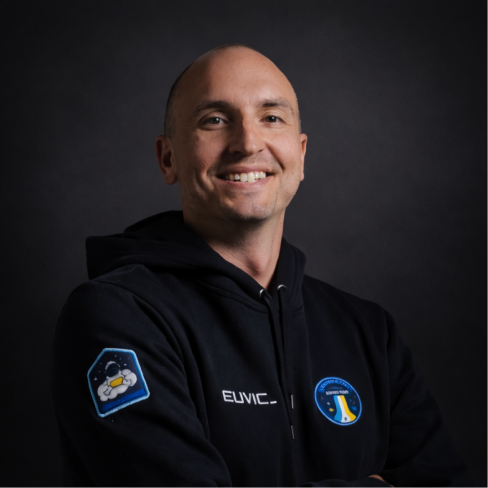
Christopher Krzoska
COO
Euvic US
Have a topic? Let's talk!
At Euvic Talks we meet people who act, not only talk. Write if you have an idea for an episode.