Culture Clash in IT Teams? | Andreas Södermark, CEO, Euvic Nordic | Euvic Talks
In the latest episode of the Euvic Talks podcast, we explore the rapid changes shaping the tech market in the Nordics. Together with Andreas Södermark, an expert with years of experience building technology bridges between Poland and Scandinavia. We discuss:
- A new market reality: An analysis of the first-ever recession in the Swedish IT market and its impact on C-level purchasing decisions.
- Efficiency over scale: Why the era of indiscriminate hiring of developers is over—and how to connect development with measurable business value (ROI).
- Work culture & communication: A deep dive into differences in hierarchy and trust within Polish–Swedish teams. How does “power distance” affect reporting and problem-solving?
- Hybrid & remote models: The challenges of building relationships in a post-pandemic world—and why “Fusion Teams” are key to successful IT projects.
- Cost optimization: When does it make sense to insource leadership roles (Product Owners), and when to outsource the “builders” (Engineers)?
Bartek: Welcome to our very special episode of our program in which we connect business and technology. And it’s so special because today we are in Sweden, Stockholm, having Andreas Södermark, the CEO of Euvic Sweden, as our guest. Hi Andreas.
Andreas: Hi there.
Bartek: Or maybe we are your guest, because I’m in Stockholm in your office. So, Andreas, before we jump into our topic, which is navigating the IT landscape in Sweden, please share your story with us. Tell us what connects you with the business and how you ended up here in Euvic Stockholm.
Andreas: So, I come from a family of entrepreneurs and most of them have built companies within the IT industry, technology companies. So I knew from a very young age that I would be in the IT industry. But I also love to travel, so for five-six years I was in the construction industry. I was traveling the world as a purchasing manager, seeing factories in Italy, in China, and even in Poland. Around 2017 I said to myself: “Now it’s time to go back to the IT industry, which I really, really love”.
Back then I connected to two entrepreneurs, the two other founders of Euvic Nordic and Euvic Sweden. They had worked with the Euvic Group since 2010 and said: “It’s a great company, great culture, low hierarchies, these are good people, you should work with them. Let’s do something here in Nordics together”. They also managed to find one paying customer that would pay my salary, and that was important for me because I have three kids and I couldn’t start without a salary. So they managed to convince me: “Let’s build an IT company in Sweden, let’s utilize the good engineers we have in Poland from Euvic and build something really close to the customers here in the Nordics”. So, 8th of January 2018, I started working for Euvic with one customer, and then as they say – the rest is history.
Bartek: That’s nice. And how you developed this department, the Swedish part of Euvic? Were you the one setting up the strategy and all the stuff, or was it some kind of collaboration?
Andreas: It’s really interesting when you use the word strategy. Already in February 2018, we had our first workshop on a strategic level. We discussed culture. Like, what should our habits be? How should we treat each other? The strategy came, honestly, years later. But to your point, what I love with Euvic Group is that it’s a bunch of entrepreneurs with a lot of freedom. Our Group CEO is really clear to all of us, saying: “You know your company the best, you know your country the best, you know your customers the best. Who am I to set your strategy? We will support you, we will have tools in our Group that you can utilize, but it’s up to you to know your strategy the best”. So I would say that yes, we’ve had conversations back and forth over the years, but we have set the strategy because we know the market best.
Bartek: Okay, that’s nice.
Andreas: It’s super nice. It’s like being this small-time entrepreneur. Here in Sweden and Finland we are 20 people, let’s say 30 if you include all the subcontractors. But we can still say, when we go to the biggest clients in Sweden, Finland, and Nordics: “We are 5,000 people”. So you can play both the small company, but at the same time you can play the big company. It’s a really cool setup.
Bartek: You mentioned Finland. Were you participating in establishing our department in Finland as well?
Andreas: Yes. We saw back in 2021 that what we were doing here was actually scaling quite well. By having local understanding of customers, local advisory, understanding how to build stuff, and then connecting it to our great engineers in Poland, we created value for our customers. We saw that Sweden and Finland are really similar in terms of culture, how they do business, how they digitize. So, me together with the COO of Euvic Sweden, who has done a lot of business in Finland, said: “Probably we should go to Finland as well”. And it just happened to be so that one of the CEO’s best friends and he used to work with was interested in doing exactly this. Sort of in an opportunistic way, but yet quite planned because Finland is a good country for us. We said: “Let’s go into Finland and let’s have Jaka on board, because together with Jaka we can build something really cool in Finland as well”.
Bartek: That’s an impressive story, to be honest. All right, let’s dive into our today’s topic. What can you tell us about the trends on the IT market in Sweden? What are the most significant trends and how are our Swedish customers adapting to them?
Andreas: I would say from a supplier perspective, the biggest trend in the market the last 12 to 18 months is that we have seen the first recession ever. The Swedish IT market has grown non-stop since the 90s. There’s even a documentary called “Eat”, meaning… I wouldn’t repeat it…
Bartek: No, please, please don’t.
Andreas: It’s a documentary around the IT bubble in the beginning of 2000 that wasn’t really a bubble because all companies survived and all companies started to digitize more. So even after that area in Sweden, the market was really strong. But since last year, we’ve seen – I just saw a report today – 70% of all suppliers are laying off people, they are decreasing investment in people. First time ever. Another way of reading the market is looking at Ework, which is the biggest consultancy provider in the Nordics – they are seeing 30% decrease in volume. So for the first time ever, from a supplier perspective, the market is weak.
If you look at it from a customer perspective, it’s really divided depending on what segment you’re in. If you are in the construction industry, there’s been a lot of slashing of IT departments because we are not building any new houses in Sweden currently. So it’s a really weak market. On the other hand, we have manufacturing companies still supplying a lot of goods to their customers with a backlog from COVID. So they’re still doing well, both from a turnover perspective but also from a revenue and EBITDA perspective. So they are still investing and increasing investment in digitization.
I think that all companies are in a situation now where digitization is a must, but it’s not as “free” as it was a few years ago when the money didn’t cost anything. Back then, all boards said: “You need to increase your digitization, you need to build stuff”. They didn’t really care about what they were building, they didn’t really care for ROI or business cases because the pressure was just “build stuff”. I think that mindset has shifted. Today, when we talk to customers, we are getting much more demands on connecting the products and processes we do to actual business outcomes, actual business value. We see big companies like Klarna, Spotify, big grocery chains – they’re actually laying off a lot of people on the quarters that used to work with IT because they couldn’t really connect it to real business outcomes.
In one area, we have big companies actually decreasing the amount of digitization because they can’t connect it to value. On the other hand, you have manufacturing companies that are actually underinvested in how to automate processes, how to increase efficiencies, or sell more through digital commerce. So they need to increase it. But one thing is for sure: you need more tight business and know what you’re doing. Just hiring developers and building up IT teams – that’s not a thing anymore. That’s a thing of the past.
Bartek: It seems like you really know the market because I was expecting an answer like: “Ah, you know, it’s the echo of COVID-19”, but you did your homework, you’re well prepared. Do you have any idea how our customers or business owners should prioritize their IT investments in this current economic climate?
Andreas: I think you once again need to be granular in the answer, looking at it from industry to industry and depending on the size of the company. I think that some companies have over-invested. Just look at what Elon Musk did with Twitter (now called X) – 7,000 people down to 2,000 people, and still the same service level, even better. And that’s crazy, but it also showcases that some of the companies like Amazon or Google over-invested in digitization. There’s even threads on Reddit where engineers boast on how little they have done the last 12 or 18 months – literally: “I’ve been hired by Amazon 18 months ago and I’m yet to commit one line of code”.
So you have those kind of big companies that did over-investment because money was free and they were going great. On the other hand, you have companies that have under-invested and need to find now cost efficiency. Because what I think is generally: turnover in industries is not growing. We don’t have a booming economy. So many industries find it hard to find more growth. Rather, they’re looking at: “Okay, how can I increase efficiency, how can I increase productivity and, honestly, lower costs?”. So I would look at the cost side of things. How can I automate processes? How can I through digital commerce sell more, or sell the same amount but with higher margins just by being smarter? I would say that the majority of the projects and products we’re currently building is connected to cost initiatives, like being smarter with what you’re doing, regardless if it’s manufacturing industry or retail industry.
Bartek: Here I have a question, because people know that we work in the outsourcing industry. Are Swedish companies leaning more towards outsourcing their IT needs, or they prefer to keep them in-house? Because you are talking about reducing costs, and I believe that maybe it’s sometimes better not to keep a few bunches of groups of engineers. Maybe it’s a better idea to outsource some crucial part of work rather than hiring all those IT specialists, which we know are not the cheapest ones on the market.
Andreas: I would say quite obviously, from a macro perspective, the trend is from outsourcing to insourcing. It has to do with the geopolitical situation we’re in – trade wars between China and US, Europe and China. That is causing all companies to overlook their supply chain and trying to shorten the supply chain, including looking: “Okay, if we were previously outsourced to India, for example, that is today a political risk”. So how can we shorten the supply chain by moving it closer to Europe, and even Sweden in our case? Having said that, of course, you could still do nearshoring with Poland, which is a great ally to Sweden. But in general: shorter supply chains.
On top of that, a good thing for companies with this recession is that there is actually more available competence on the market than it used to be. Some of our customers said: “Well, we tried to hire a good Product Owner last six years, we had no applicants. This year we have six or seven applicants”. So I think companies both can and will hire leaders internally, like Product Owners, Solution Architects – those who, as this podcast, need to be both business and tech.
I don’t see that they need to hire engineers. Because as you say, it’s really expensive to have a great full-stack team that does front-end, back-end, and databases for all technologies needed for all products. I think – and I see that as well in the market – that companies are insourcing the leaders, but they are still open to source the “builders”, so to speak. But not too far away, given the political reasons. So they could source builders here in Stockholm or other cities in Sweden, but also source from Poland. That is a matter of seeing how much you have in the backlog and balancing cost versus risk.
Bartek: That’s nice. And there’s one positive thing that I recently liked to underline in terms of hiring engineers from an outsourcing company: they have a huge history of different organizations they used to work for, and that knowledge can be brought to our customer. That’s something that an in-house team doesn’t have.
Andreas: Correct. Here is a challenge in the market, because all customers want to hear how unique they are. If we say: “Well, we sold a similar integration platform in another industry”, they don’t listen, even though it’s the same business problem with the same technical solution. They want to know what you did in their industry. I think when it comes to maturity from a buying perspective, customers need to realize the strength of having external competence that has seen a lot of different and similar projects that will help them do it faster than having an internal team that for the first time will do the project.
So I think it’s a real strength, but I’m finding it difficult to reach our customers from that perspective. It’s sad, because it’s said that 99.5% of all projects fail to deliver in time, budget, and quality. One of the main reasons is that we do so much new stuff in the IT industry, so we never get these repeatable patterns. So if you want lower cost, you should actually go to an outsourcing partner who has built similar products for 10 other customers, because the 11th time will for sure be faster, smoother, and less costly than the first time you’re building stuff.
Bartek: I agree. You know, our AI engineers always keep on telling me that no matter the industry, no matter the problem, for us data is data. Just provide us with data and we can…
Andreas: Correct, we can. And integration is integration as well.
Bartek: All right, let’s move on. Let’s talk about the differences in culture. What is unique in the Swedish market that might be challenging in terms of collaboration between the Swedish business part and the Polish tech part?
Andreas: It’s been said that the biggest advantage for the Swedish society is that we are a “trusty society”. We trust each other. Regardless if you’re the CEO or the janitor, we see ourselves on equal footing. We take words for granted. And that is measured in “power distance”. When you look globally, you can measure the power distance. The power distance in Swedish companies is really low. We trust each other. Regardless of your position, you’re welcome to have an opinion and welcome to have a say.
Poland is not a “trusty society” in the same way. When you look at the global measures of power distance, Poland has a quite high distance between the CEO and the janitor. So what’s difficult from time to time is for me and our leaders in Sweden to be clear enough to be seen as a strong leader in Poland, and also the opposite – to actually understand how much trust we put. There are times where I’ve seen that reports are being “polished” because they don’t know if they can trust what we will do with information, because the power distance in Poland is higher. In Poland you probably polish a bit more your story to make sure you don’t look bad. In Sweden, you don’t have to do that.
That’s why I’m really happy that we, for example, have worked together for six years. I think we know each other even more, so we are starting to understand the cultural differences. But I know for a fact when we try to work with a new delivery team from other parts of the Euvic Group, there is a period of not really understanding. We think we understand each other, but there are differences. That’s why we have chosen to work more with people we have already learned to work with. We’ve built this cultural bridge, because there is something to bridge. How do you see it?
Bartek: Oh, that’s a very good question, I haven’t thought about it. You know, for me… I will answer in a funny way. For me the most challenging part in collaboration between Poland and Sweden is when you all go for a vacation period – there’s nobody on your side for almost two months!
Andreas: Yeah, correct.
Bartek: But apart from that, yeah, I believe that communication is the key, as usual. I have the same feeling as you, that we had a chance of working together and I think we know each other and we trust each other. But I remember that at the beginning it was a bit rough. I can totally agree that the cultural differences exist. Sometimes we should be more open-minded – even if I don’t understand what you mean, be at least curious of what you wanted to say to me and repeat my questions, ask more questions just to be on the same side. That’s how I see it.
Andreas: Totally agree. I don’t know if it’s totally true, but the other founder of Euvic Sweden, who actually moved to Poland, said that his analysis is that part of the differences stems from our school systems. In Sweden, all teachers are facilitators of knowledge to ask a lot of questions to the pupils to find the answers themselves. But in Poland, you have a quite authoritative teacher: “This is the way”. So you are more fostered into thinking there is one person who has all the answers and we should follow that. Whereas in Sweden, you’re fostered to have your own thinking, so we are a bit more curious.
On the other hand, when you look at research showing the skill of a Swedish engineer coming from university – it’s said that a Polish engineer is five times better in mathematics the first five years. Great problem solvers when the problem is scoped. However, when you’re supposed to become senior, it’s more about: “Am I solving the right problem? Am I asking the right questions to right stakeholders?”. Then the Swedish engineer is more productive because we are taught to be more open and curious.
Bartek: Okay, haven’t heard about this one, but I think at some point we should have another episode about this. Going back to the topic and the challenges: do you see that it’s challenging to properly manage remote work, building new or improving existing software products for our customers? Because there are a lot of things to manage: business collaboration, setting priorities, and passing them down to the engineering team.
Andreas: Honestly, I think it’s really difficult. Honestly. Just look at Eric Schmidt, the former CEO of Google. He had a session at Stanford last week and he said: “We are losing the AI race, we’re losing Google as a company, because we have grown so remote, so fat and happy. People don’t show up for office, they don’t care too much about business outcomes, they care about having a nice lifetime” – that was his word. Google is supposed to be really ambitious and hardworking, and he said: “We’re losing because we have that remote-first, super generous approach to people”.
I would say that remote work is here to stay. I believe that life is too short to just say that work is a place. However, I don’t think we can take it so far that we are 100% remote, never work together in the office, never get to build this relationship. Because it’s been said that your relationship depth dictates how much complexity you can solve. Let’s say that we have a customer, we are new to them, they are new to us, we scoped the business problem quite nicely, but then we also put together our new remote team that never worked together… all these unknowns, this “forming and storming” until the team becomes productive – we are wasting massive both time and cost for customers and ourselves.
Bartek: And that would be my next question. Because I usually prefer hiring people that are able to find themselves in one location when needed. Because of course, times have changed and people like working remotely, and I’m not saying that we should not allow that. But I find it highly beneficial when people are ready to gather to work together when there is a need for that. From your perspective, from the business perspective and maintaining a good relationship with our customers, do you have any tools and practices that make those collaborations more successful, more long-term?
Andreas: We used to have a rule saying that we don’t start up collaborations without being one or two weeks on-site. That changed with COVID because for two years we weren’t allowed to fly, we weren’t allowed to meet them. Since then, most companies are so digital-first that even if we want to have these startups, they don’t want it because they have people sitting remotely. So this is a joint problem to tackle. Even though we say: “We want to be on-site at your company for two weeks”, most will say no to that. Having said that, I think we still need to invest in upfront relationship building. Having workshops together, having a dinner together, having fun together. And of course, then we have digital tools like Miro and other workshop tools where we can be collaborative together and share information. But I don’t think there’s any shortcuts to building real relationships, and I think it’s become increasingly difficult since COVID.
Bartek: Yeah, and I agree here. I was repeating that we don’t build software FOR the customer, we build software WITH the customer together. Without a strong relationship, we as engineers are not able to deliver what the customer really wants.
Andreas: Correct, that’s the essence. We even call it that we set up “Fusion Teams” – fusion between the customer and us. It’s not two teams, it’s one fusion team, supposed to drive the project or product towards the customer’s goals.
Bartek: Totally. Maybe one more question: how do you make sure that you choose the right people, the right team to respond to your customer’s needs?
Andreas: It’s been a journey, I would say, honestly. When we started in 2018, I had too little experience. So I had to trust both the customer saying: “This is the problem we need to solve”, and also the engineering teams in Poland saying: “Okay, we know how to solve this”. History has shown that neither the customer knows all the problems, neither can the Polish engineers understand what the customer itself doesn’t understand.
That’s why we’ve spent the last three years building an advisory team here in Nordics, containing of old CIOs, CDOs, CTOs that can make sure that the customer frames the problem in the right way and start solutioning that in the right way, so the Polish engineers get the right conditions to do good work. In that, we also start looking at team composition – knowing the Swedish customer and their problems, knowing the Swedish culture, knowing how Poles are and how good they are on their strengths, and how to make the best of it. What I learned over the years was: when I let the customer itself decide what they needed and the engineers themselves decide “Okay, we know this or not”, we made too many mistakes. Today we have a much more controlled process of gathering requirements from the customer and matching that with the right teams in Poland. Today I’m super happy about how it works, but it’s been quite a frustrating journey because it took many hours of blood, sweat, and tears – mostly from the engineers in Poland that had to work overtime and over weekends to fill the gaps that we missed in the first scoping phase.
Bartek: Are there any recently delivered successful stories that you would like to showcase?
Andreas: For sure. I think that – without mentioning any specifics – two years ago I would say that the majority of our projects had issues when it came to time, budget, and quality. Today, 90% of the projects are “green”. Meaning: we’re keeping our promises to the customers and we’re keeping our promises to our engineers. I think that is the major success without mentioning any of the ongoing deliveries by name.
Bartek: What has recently inspired you? It can be an event, a book, a film, a journey…
Andreas: I would say so many things. I try to be inspired by life every day. From how my kids tackle their new schools, to the latest book I read on how big projects are done, to meeting you. I try to be inspired every day. It’s such a cliché, but I think that’s the way we should live.
Bartek: Okay, very short but very productive answer. Thank you for that and thank you for being our guest, or me being your guest. Thank you for coming to Stockholm. Thanks again, thank you all for watching today’s episode and see you next time.
Meet our guest
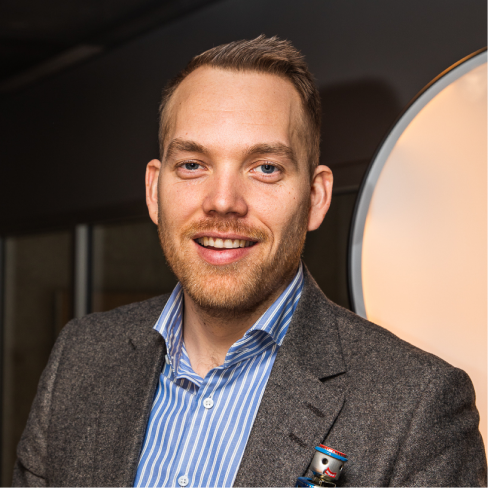
Andreas Södermark
CEO
Euvic Nordic
Have a topic? Let's talk!
At Euvic Talks we meet people who act, not only talk. Write if you have an idea for an episode.