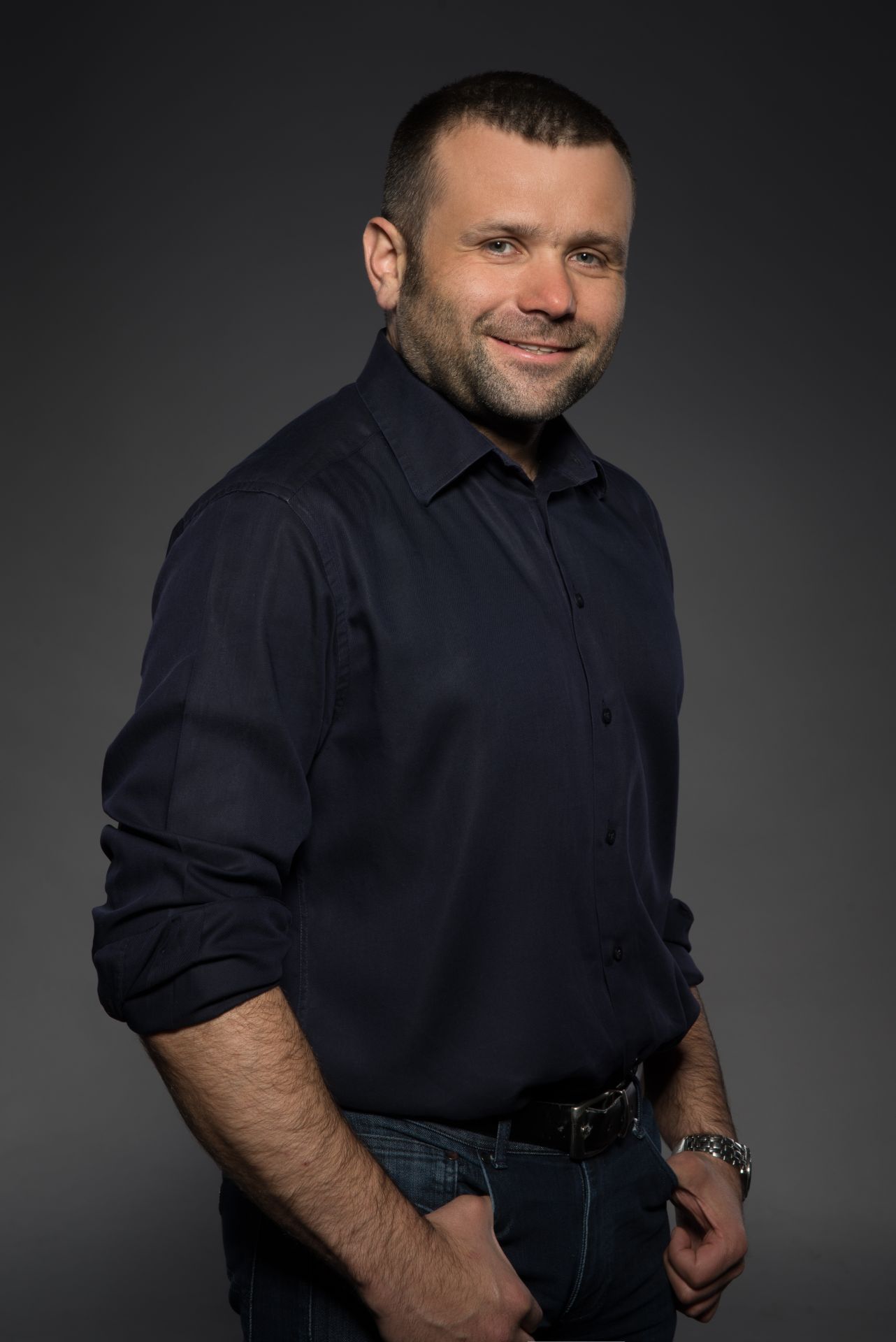
Bartek: Welcome to another episode of Euvic Talks, where we combine business and technology. My name is Bartek Śliwa, and my guest today is the CEO of Euvic, Wojtek Wolny. Hi, Wojtek!
Wojciech: Good morning, hello!
Bartek: The standard opening question is always: what connects you with business? But I think in this case, the question isn’t quite necessary. However, perhaps you’d like to share something interesting that has happened recently in your professional life?
Wojciech: I think that’s a great question, though in my case, one might ask: what connects me with technology? In fact, both questions have the same answer: I was a poor engineer. It was because I was a poor engineer that I ended up in business. As for technology, it’s my education that connects me to it. What’s happening in business? A lot. We’re doing a ton of acquisitions. I think the whole business environment is changing rapidly, so that’s probably a topic for a much longer conversation. But as they say, if someone isn’t cut out to be an engineer, they end up in business.
Bartek: I think that’s a very humble answer, but you mentioned the business environment. My question is: what is it like today? What are the current trends? Are we still feeling the effects of the pandemic? Where do AI, cloud, IoT, and process automation fit into all of this?
Wojciech: I’d probably put the pandemic aside by now; it was just a temporary disruption. Looking at the world’s dynamics today, we’re talking about 4 or 5 years ago—in technology terms, that’s starting to sound like prehistory. So, let’s look at the economy instead. In Poland, we’ve crossed a “magic boundary”—moving from a developing economy, which grew fast based on cheap labor and simple services, to a developed one. This change applies to IT and every other sector. The era of building prosperity opportunistically on low costs and body leasing is coming to an end. In developed economies, the IT sector looks different. The “software houses” that built custom software based on lower costs will soon be a thing of the past. In the age of AI and automation, consulting and “mature technology” like Product Discovery and specialization will matter more. We won’t be talking about a “great Java developer,” but an expert in energy, healthcare, or logistics. Technology will follow—it will become friendlier and easier, reducing the need for manual, tedious coding.
Bartek: Do you feel an increased demand for outsourcing services in all of this? Will there be more software development, but “covered” by this consulting? Which way will it go?
Wojciech: The word “outsourcing” is a very broad definition. We say we outsource infrastructure maintenance, body leasing is a type of outsourcing, and hiring someone to write an entire app is also outsourcing. So, the demand for technology services will grow, but the services themselves will change. I have a theory on this—there was a lecture by a professor from Columbia University who said honestly: no one knows exactly what it will look like. We all intuitively feel AI will change the industry like the internet changed the world. Since we’re all just guessing, my guess is that source code will be generated much more easily, faster, and automatically—therefore “cheaper” in quotes. If a programmer gets a tool that allows them to produce five times more code, what does that mean for clients? If even one competitor does it, the rest will have to follow. They won’t cut budgets; they will generate more needs. And to manage those needs, they will need more consulting and an understanding of which systems actually make sense.
Wojciech (cont.): I’m surprised more people aren’t talking about the infrastructure side. Data in the cloud is doubling every year; it’s an exponential function. Soon, the problem won’t be writing the system, but the infrastructure required to run it professionally. Systems will be more advanced and power-hungry. The monthly maintenance cost—electricity, Data Center space, and cybersecurity—will be more significant than the cost of writing the code itself. We are moving toward industry-specific consulting. The winners will be the firms that don’t just say, “we’ll write you a system,” but “we’ll show you how to increase your margin by 3% using technology.”
Bartek: I can feel you strongly believe in this vision. How is Euvic adapting? Have we already taken steps to offer these better infrastructure services you mentioned?
Wojciech: It’s funny because the glass is always half full and half empty. Our roots and heart have always been with programmers; we come from software development, specifically the mainstream Time & Material and body leasing models. A pessimist might say we’ll have trouble there. But on the other hand, for many years, we’ve had a very strong “infrastructure leg.” We are one of the few in Poland heavily involved in Microsoft solution distribution. Our latest investment in Senetic significantly expands this. We expect to approach a billion PLN in revenue from this area alone. Senetic operates in 20 countries, distributing cloud licenses and network devices—everything close to the infrastructure. This provides a solid platform for growth. On the service side, we are focusing on team development and acquisitions. Recently, we invested in Tuatara (heavy consulting component), Med-Team (healthcare sector), and a logistics startup team. We are also proud of companies like Sirocco, which developed a strong Product Discovery area. We aren’t going to be a “dinosaur” that refuses to change.
Bartek: Is this strategy based on your gut feeling or a response to market needs?
Wojciech: It’s a mix. Some things are opportunistic; others are strategic. It’s a continuous process—like a puzzle we’re trying to assemble. For many years, infrastructure was seen as a low-margin “necessary evil” by software-heavy integrators. But with cloud distribution and cybersecurity, there’s now a huge space for services. Designing a smart hybrid architecture and monitoring it 24/7 is something few providers can do reliably.
Bartek: Regarding Senetic and its 20-country exposure—how does international expansion look for Euvic and the rest of the group?
Wojciech: We have our traditional markets. We’re very proud of our Swedish team, despite current currency fluctuations—the Swedish Krona devalued by 20%, which hit profitability, but that’s temporary. Finland is also developing well. Our first foreign venture was in the US, and today it’s the “jewel in our crown” with a new generation of managers and a strong team. We’re learning the UK market. Senetic complements this map perfectly with strong branches in France and Italy, where Euvic was previously marginal. Then there’s Ukraine. We are one of the few investors still there, with four entities and a fifth on the way. It’s dual-purpose: we build engineering capacity there, but since the internal market is small, those firms are export-oriented toward the US, Germany, and the UK. And finally, a bit of “exotica”—our Dubai office. We’re finishing a large public sector project there which could open many doors.
Bartek: You have a lot of momentum. What are the challenges? Scaling usually brings talent shortages or legal hurdles. How do we handle that?
Wojciech: The labor market has changed. It’s actually easier to find good people now. For a decade, it was a “candidate’s market.” Today, that’s rebalancing. We don’t have major talent challenges right now. Legal challenges are “boring”—we handle them with a mix of in-house expertise and external firms. The biggest challenge is actually operational cooperation between 100+ companies. Our “superpower” is consolidating the market and investing, but we aren’t yet masters of operational excellence—there are many firms better than us at that, and it’s our biggest challenge moving forward.
Bartek: You mentioned investing. Euvic has appeared in the shareholding of several public companies. Why? Is this a dream of going public?
Wojciech: It’s not a “hidden” dream—we’ve publicly stated we want Euvic to be listed on the Warsaw Stock Exchange (GPW). I’m rooting for big IPOs like Zabka because they bring in international investors. Going public is good for us for several reasons: First, we can offer share swaps to subsidiaries. Second, we can offer real stock options to employees. Third, transparency—international partners and banks trust audited, public companies more. Fourth, we can use shares as a “currency” for more acquisitions. Our presence in five public companies was a way to “learn the ropes” on a smaller scale—to understand how they function, how to talk to investors and funds. It’s like playing in a lower league before entering the “Extraklasa.” Our investment in Unima 2000 was a flagship project for this learning process. Soon, we will announce how Euvic itself will become a public company.
Bartek: Which will happen first—the IPO or more acquisitions?
Wojciech: We just finished a massive investment in Senetic. It’s hard to say we have an even bigger one ready, but I’m always scouting. Market consolidation continues. I hope to close another significant transaction in the infrastructure sector by the end of the year. Our subsidiaries are also investing—xCode, Euvic IT, Med-Team… we are building an investment culture where companies realize projects important to their specific growth.
Bartek: Let’s play fortune teller. The future of IT: people said AI would take our jobs. Where will the sector be in 5-10 years? AI, blockchain, cybersecurity?
Wojciech: I actually disagree with the premise—AI will take our jobs, at least as we know them today. If we think a coder will still be sitting there manually writing lines of code in 10 years, I’d bet against it. Coding will be machine-generated. We are at the very beginning of this road. AI will do to IT what the power loom did to weaving. It’s about democratization and demonetization. My son, in his second year of university, can deliver a professional IT solution that used to cost millions, just by using Large Language Models. It will destroy old jobs but create entire new sectors. I’m an optimist—it’s an opportunity for our economy. As for blockchain, I was never a fan of the “currency” side or the energy waste of Proof of Work. But blockchain as a source of data authenticity will grow in importance.
Bartek: Is the group taking steps to be ready? R&D, startups?
Wojciech: We are taking “baby steps.” Even entire countries can’t afford “giant steps” like building their own LLM for a billion dollars. We cooperate with universities and test technologies internally. For example, using ChatGPT to structure our massive internal intranet. We’re doing AI-driven code migration for clients. Service firms like ours won’t be the “avant-garde” creating the next Google, but we are the “shovel sellers” in the gold rush. We are learning to provide services in a world where teams might be smaller, but infrastructure and project complexity will be much higher.
Bartek: One last question—do you ever feel the “solitude of the entrepreneur”? The feeling that no one understands your complex problems? How do you cope?
Wojciech: I confirm that ailment exists. Sometimes you can’t even explain a problem to your wife or kids—the “puzzle” in your head is just too non-obvious to translate into words. I’ve addressed this through Corporate Connection, an organization of large-scale entrepreneurs who speak the same language. I’m part of a “forum” with more experienced entrepreneurs I can learn from. It solves that problem of isolation.
Bartek: What has inspired you recently?
Wojciech: A simple inspiration: I discovered a new field of motorsport—Drifting. It’s the third thing I’ve decided to learn as an adult. First was skiing—I spent 10 years mastering it to become an instructor. Then Enduro motorcycles—I spent 10 years learning that and finished the world’s toughest rally, Red Bull Romaniacs. A year ago, I discovered drifting and I’ll spend 10 years learning that too. I want to be an “advanced amateur.” It teaches humility. When I first sat in a drift car as a passenger at 120 km/h, I wasn’t impressed. But then they let me drive on a track in Poznan—and I was hooked. I bought an old BMW on OLX and started my “homework.” A year later, I won my first pair in a competition. It’s about a total mental reset and being open to chance.
Bartek: Wojtek, thank you so much for today’s episode. To our listeners, thanks for watching and listening. See you in the next one!
Wojciech: Thank you very much. See you.