From SaaS to Trust: Building a Fintech Brand | Marcin Tuszkiewicz, CEO Squaber | Euvic Talks
In a world where information reaches us in a fraction of a second, the real value lies not in access to data, but in its interpretation. Marcin Tuszkiewicz, CEO of Swuaber, in a conversation with Bartek Śliwa, explains how modern technologies are reshaping the way investors and business leaders operate.
In this episode, we cover:
- The evolution of fintech: How to move from complex tools designed for professionals to intuitive products tailored for management teams.
- Technology in service of time: Squaber as a filter that enables decision-making in 15 minutes instead of spending hours analyzing financial statements.
- AI and algorithms: A breakdown of the difference between “trendy AI” and real algorithms that have been supporting investment decisions for years.
- Leadership through observation: How the experiences of other leaders (Rafał Sonik, Wojciech Wolny) shape the approach to building large organizations.
Bartek: Hi, this is Bartek Śliwa. Welcome to another episode of the Euvic Talks podcast, where we connect business with technology. And today, what business loves most — money — as my and your guest will be Marcin Tuszkiewicz. First and foremost, the most important role you have for me today is that you are the creator and CEO of Squaber, an app supporting investing. Hi Marcin.
Marcin: Hi. Warm greetings. Welcome everyone. Yes, you’re right. I’m the co-founder, currently the CEO of the company that owns Squaber as an app, among the things we do. But yes, it’s an app for stock market investors, helping to find opportunities, helping to find or better understand markets, especially in Poland and America.
Bartek: So Marcin, from idea to product — where did the idea for Squaber come from?
Marcin: You know, we started out in 2012 by founding a service called Investio and it was a dedicated service, there was a toolset, various tools for investors that were quite unspecified, all over the place — for traders and long-term investors alike, scanners, no scanners, that kind of thing. But we noticed that since the group wasn’t specified, we weren’t really hitting the mark, because nobody knew how to find their way around, so we simply did market research on which social group is the largest and which could pay us money. Very simple research. It turned out that middle-aged people in managerial positions who have money, can invest, and often want to — but don’t have time — would be the most rewarding group, back when we did that research 10, 11 years ago. So that’s how the app was born — its primary and overriding goal was to save time for people who use it, but specifically people investing in the stock market. So we weren’t interested in educating people to start investing, although we do that too. But we’re more interested in helping those who already want to do something, are doing it, and simply lack the time. So first and foremost — research, right? What is actually the need, what is the pain point. And we try to solve it, solve it in a way that keeps customers happy.
Bartek: Right, to keep customers happy. I’ll admit that since 2018 I’ve also been your happy customer and I’d like to…
Marcin: You’re not middle-aged. But that’s good for you, because since the pandemic and just before it, the average age of Squaber Premium users dropped by 10 years — from 40-plus to 30-plus — and that’s a trend in Poland.
Bartek: So I’m already the target.
Marcin: Yes. That’s right, you became it. I mean, that target quickly… It’s actually interesting, because usually users mature into products, but here it happened that this maturing came much earlier, because of the pandemic, because of crypto — all of that caused people in Poland to start investing at a younger age, so the average simply dropped that way.
Bartek: We’ll get to that. I have it on the list. Okay. I wanted to come back to the question of this. Finance in Poland is unfortunately still associated with something difficult, heavy, something that requires a lot of time to get into. And I remember when I came across Squaber, you, who gave me a discount at the Invest Cuffs conference in Kraków — I was won over by the simplicity of use. But I assume there were some challenges behind that, so I’m interested in what challenges appeared in your business journey when combining market data with that simplicity of functionality and usability of the Squaber app interface.
Marcin: Well we had… it’s actually something amazing, because we found a very, very good designer right at the start who designed Squaber in that first phase, and he managed the most important thing — selecting the most important information with our help and placing it well. The UX/UI was very important in Squaber’s first phase. You joined Squaber when it was already in the development process for the second phase, and today we’re before the third phase. Roughly speaking. But that second phase was based on the fact that I also happened to join at that moment, or took over control and full management of the company as CEO, in order to bring our app to a larger audience. So we started adding certain features, but we always follow what our user actually needs, because you can add a million pieces of information, indicators, parameters. We constantly receive requests from users to, for example, why don’t you build an API, or why don’t you do such and such. But our user doesn’t need an API, because they simply won’t use it. Parameterization of indicators isn’t needed. They want to receive information about whether to buy or sell based on proven parameters, rather than figuring out which parameter is best and most relevant. So what I think we did well is that we restrained our urge to build things for professionals and instead focused on our actual audience — someone who has little time, has money, and doesn’t want to search, dig deep, research, analyze. They just want to receive.
Bartek: Okay. And what was the key scaling moment on that path? What clicked?
Marcin: The pandemic helped us a lot here, but what’s important is that we had already started growing more strongly before the pandemic, and here’s the interesting thing — we’re a SaaS product that in 2018 I wrapped with myself, in the sense of a personal brand, and that probably drove growth of practically 100% over two years, and then the pandemic was times four — over the next several, even two years, times four. But generally this personal brand means that trust grows in the world of finance, and here we really rely on that — so beyond the SaaS product, which Polish users weren’t so used to back then. That has changed now, but when we started it was a novelty. I added this personal brand, going out to conferences, meeting users at Squaber Invest Day for example, or at conferences like the one with you at Invest Cuffs. All of that paid off in my opinion, but it’s unique — here we live in the world of finance where trust in the person who’s speaking to you has to exist. I think every product has its own little tricks that suddenly make the business accelerate. But we’ve also hit a ceiling now, which is why I say we’re before a third development phase of Squaber, where we need to redefine our user, because there are quite a few users like you in Poland as far as…
Bartek: I felt special for a moment.
Marcin: Yes, because that’s how it is — people who are motivated, who have money and despite a lack of time are engaged in active investing. A much larger group of people has grown in the wake of ETFs, toward more passive investing. And here we’re looking for a space where we could find our place — people who have money, don’t have time and don’t want to spend it, but want to invest, right?
Bartek: We’ll get back to Squaber in a moment, but you brought up the personal brand factor, and I also remember the pandemic crash and the pivot you made — really you made it — and you started doing live streams practically every day. So I understand that your daily presence and those market comments, also a bit of cooling emotions, was what fed the fire. Right?
Marcin: The biggest value we give users — they tell us this themselves — is peace of mind in making decisions, meaning no erratic back-and-forth, just calming down, as you mentioned. That’s the first thing. The second thing is that we protect against scams — because if someone finds us, they won’t let emotions lead them to lose money in some shady brokerage or shady investment. So we provide — however bizarre it sounds in the world of investing — we provide a kind of safety. Not because our signals are 100% effective or our tips are always right, but because when someone is with us, they’ll never lose a lot. Because there’s no possibility of that, since we manage our investments in a way where the risk is calculated. So this combination of two things — the calming and the safety — is something I also managed to build through the video content you noticed. Being on practically every day — now I’m less frequent because you really can’t sustain that pace — but for 2 years I produced content daily, plus Sunday video content, so practically six days a week, Saturday was the only day off. That led to a situation where people got very used to it, right? And they actually listened to the content because a lot was happening. Then there was a bit of a calm period in 2023/24, but now a lot is happening again thanks to Trump. Anyway, we managed to organize this work a bit better, divide it up, and keep delivering that calming information and market commentary, but with a somewhat lower workload.
Bartek: Okay. Getting back to Squaber. What technological decisions turned out to be good or painful?
Marcin: Oh, that’s a difficult question, because there were an insane number of decisions. I think a very, very good decision was to integrate with TradingView. That was quite a long time ago, because for the first year or two we had our own library, we were developing our own charting library, but we pretty quickly realized that it was a bottomless pit — you could just burn all your money trying to do it right. And we were the first in Poland to integrate with TradingView at a level that… well, there’s no second integration like it even today. Now brokerages are catching up, some are making such integrations, and later came investing.com, so we were pioneers in that area — that was definitely a good decision. The wrong decisions were probably driven a bit by circumstances, because we built some things outside the main system — to speed up work we pulled out certain modules, for example those calculating signals, outside of Squaber. We did this in other programming languages that my co-founders or I, my partners, were familiar with, so as not to burden the IT team, because at a certain point in development we really wanted the cost of producing another service to be as low as possible. Starting the cooperation with the Euvic Group was also a kind of switch in our operating model — for about three or four years we hired our own developers. Then there was a transitional period where I was taking over the management and we had only one developer working in-house, while the rest we delegated — and that’s also a good decision in my opinion, delegating things to external companies, because we had flexibility, and in our business that flexibility was very important. Only now, I think, do we feel the space again to build those teams, but I don’t feel the need, because we have this collaboration. But technologically, it was definitely a mistake — and a huge one — to develop features in that second phase without caring about UX/UI. Meaning, due to what I just described — the desire to minimize production costs for a new service within Squaber — we had to cut certain things, but that was a cost that I believe is coming back to haunt us, because now we need much more time and energy to bring it to a form that would satisfy me — one that will be great for users.
Bartek: Okay. What is Squaber now and what will it become in phase three? You have quite a few features. I assume you’re no longer a startup. You educate a bit, inform a bit, provide tools. So how do you classify yourselves now and how will you classify yourselves in this new phase?
Marcin: I’d like Squaber to become more SaaS-like, even more SaaS-like. As I said, we wrapped this SaaS product with me, and now I’d like… and there was a very strong emphasis on developing this presence among investors and developing things that are needed somewhere, without focus on the product as a product in terms of UX/UI and that kind of thing. So now the emphasis is being placed on making it more competitive. Because I believe the only place and the only chance to scale very strongly is going international, and there we need to catch up on things that were neglected over the last two or three years. Well maybe a bit more now. So what will Squaber become? It will become first and foremost a platform — we’ll step down a little, meaning we’ll become a platform for people who are just starting to want to invest. So if you don’t have any stocks yet, but it’s dawned on you that it might be worth it, Squaber should be the place you end up and learn how to do it properly, safely, and how not to lose more than what you sometimes need to risk, right? So we want to step down a bit in terms of the declared service, because we’re doing it anyway to some extent, just as you noted — we do a bit of education, a bit of this and that — and I’d just like to organize it and make it more of a SaaS product, so that it would no longer require me to sit down and record every day, but rather be timeless things that simply help along the way. But that’s not the only thing, because for current customers the funniest thing is that if we had buried Squaber ten years ago, done nothing with it for 10 years, and released it to the market today — everyone would be happy, because I could write that it’s event-driven by AI and everything else, because that’s how we started. Except that because of how the market looked 7/8 years ago, we had to add everything else. We had to add individual people who say and explain things. Because people didn’t believe in automated systems, and we had fantastic signals with fantastic statistics, but again they’d need to be buried for 10 years. So that’s the third thing I want to do — bring our algorithms back out and support this SaaS product with the automation we have, right? It just needs to be dug back up and probably updated from Python 2 to Python 3.
Bartek: Right, and here we’ll smoothly move to the topic of how technology changed the market since 2020, since the pandemic, because you mentioned it gave you a business boost — people stayed. I remember those swings. I remember when I was still talking to my developers, they were buying airline stocks because they had dropped so much and were bouncing back quickly. How has technology changed since then from your perspective, but also from a broader perspective as you look at the market as an investor?
Marcin: The market is faster and it’s remarkably so, because since the pandemic, where the pandemic lasted 6 weeks, the drop on markets lasted six weeks. There had never been anything like that in history — there had been single-day drops, some flash crashes. But a bear market lasting six weeks — never happened. And since then everything is faster. Peaks are faster, bottoms are faster, cycles are faster. I don’t know if the world will stay that way, but my theory is that the internet accelerated the transformation of information, the transmission of information. Today we live in a world where information is instant practically everywhere. There’s no limitation on the delivery of information — if someone puts it on the internet, it’s there immediately. And technological solutions, especially AI now, have caused the processing of that information to be even faster. So while we had the transmission of information, processing was the problem, because someone had to know what they were doing, someone had to read it, translate it and then do something — now those barriers have disappeared, so we again have acceleration, not of the information carrier itself but of the absorption and use of information. So following that trail, probably there’s no point counting on us living like 30 years ago, where things moved along slowly — the information is faster, markets are more dynamic and this causes the world, because that’s how it looks, to require us to make more decisions faster, and people are losing the space to do so. Unfortunately people are overloaded with information reaching them and often instead of making a decision faster, they withdraw from making a decision at all, because they’re simply overloaded. And that’s a problem not just for investing, but for the whole world. Looking at social media — I for example don’t follow any social media. You can’t do it. I only have my own channels that supply me with information, because I know how easy it is to lose half an hour scrolling Twitter. For example, when theoretically those are things I should know about, because they’re things from my industry. But no — you need some filters. And again, Squaber is supposed to be that filter for our users — so that there’s as little information as possible, counterintuitively, but only the information that counts.
Bartek: Right. And now let’s maybe do a little educational mini-segment. Give an example of how your alert works versus the classic way of following a company — in the way people also see the stock market. Because I mentioned that we often perceive finance as something heavy, and the stock market is an even bigger caliber for most people.
Marcin: Generally, first of all, when tracking information you have to understand it, analyze it, understand it, make a decision about it. And the communication that happens is often written either in legal language — because ESPI communications, the ones that come from companies, are legal — or press releases that are vague because nobody wants to take responsibility for what’s happening, they’re simply passing on information. Squaber condenses all of this to tell you whether to buy or sell. 80, 90% of the content we generate in written form are communications that give you information about what we think. We aim for roughly that level. Beyond that there are video materials where more of the content is explained, to also transfer a bit of that educational thread through learning by practice. So when I see, for example, the team sending a comment, and when I read that comment I don’t see a conclusion about whether it should go up or down in our opinion — my first question to the team is: why did you send this? Because our user, when they read such a message, wasted a minute for example. No, because they don’t have Squaber to read news. We are not a news service. We deliver news within ESPI because we have to, but we’re not an information portal — we’re an opinion-forming portal.
Bartek: Okay, so your alerts allow for the interpretation of market data and presenting it to your clients in a digestible, short, concise way, so that based on it a decision can be made about buying or selling a given asset.
Marcin: Yes. I mean, everyone should be guided by their own reasoning, their own strategy. But what we do should make life easier and help make that decision faster, with less expenditure of energy and time.
Bartek: Okay. So what data does Squaber analyze and how does that support investors’ decisions?
Marcin: We analyze financial data and stock quotes. When it comes to automatic actions, we have algorithms that look for opportunities based on volume, on price — those things that are absolute — but also on indicators. We currently have three fully automatic strategies, plus a few more waiting in the pipeline to be implemented, but also ones I use in video content or in signals we send manually to our users. We also analyze financial data in a fairly non-trivial way, because we don’t deliver raw data — we assume again that our users don’t have the time or inclination to analyze a balance sheet, so we indicate a company’s rating based on three types of financial analysis: comparative analysis, ratio analysis, and dynamics. So we look at how things changed over time, how they changed in structure, and how they compare to other companies of similar capitalization. That was new in Poland a few years ago. I still see that there aren’t really many strict financial ratings like that. But in the world there are a few such rating companies, let’s call them automatic ones. The most well-known is Seeking Alpha, which has its own parameters. But there’s also a small company, a service called Wall Street from Australia I think, where they also have ratings, matrices of the type like ours. But that’s the element I’d most like to develop in the near future — to expand to other markets. And give that kind of support on a broader spectrum. The third thing we do is analyze and send, or rather comment on information. Because again we’re trying to make life easier for people, so when information comes in we try to interpret it for our users. Not all of it, of course, because that’s impossible, but the ones that interest us — us as the Squaber team or our users. In any case, I’d like to get to a solution that will automatically report financial statements, but not just financial statements — also communications from companies such as interviews and that kind of thing. And again our thought is that we don’t give the user a tool so they can prompt AI about what was said, but so they receive what’s most important through our best-generated prompts, the best machine learning in that area. So what we want to do is use the technology that’s developing today to again speed up and make life easier for our users, because again each of us can take ChatGPT and type something and connect it. There are probably solutions that would let you do that in a few hours, but our users don’t want to bother with it and would rather pay for it.
Bartek: Well, you brought it up, not me — namely the buzzword that is AI. What role does AI play or will it play in Squaber’s third phase? You mentioned you already had algorithms 7 or 10 years ago ready. Was that already AI, or were those just some parameterized algorithms? And AI by definition can be wrong — it’s not an infallible solution. In this type of industry, namely finance, are those errors okay, or are they not permitted? How do you deal with that and how do you see it both through the eyes of Squaber’s co-creator and through the eyes of an investor?
Marcin: As for — maybe I’ll start from the end, meaning from the user of such solutions — for me, purely LLM-based solutions are great for chatting. But in the strictly financial world they unfortunately leave too many hallucinations. Those very open models. The solution is models that work exclusively on a closed data set. That gives more trust that they’ll produce what makes sense. And there I see a space where we can deliver something good, but I’ll keep that to myself for now. At least until we do it. But when it comes to our solutions — we used genetic algorithms right from the start, so I’d say artificial intelligence at some basic level, organized a bit differently. The solution we still use today — support and resistance zones — they sort of learn on their own, educate themselves, not in an LLM way because there’s no need for that model there, but I’m not sure exactly what model — these are solutions bordering on artificial intelligence or even utilizing it. And what guided us from the very beginning was creating an algorithm that would optimize the moment of sending a signal in accordance with the strategy’s assumptions. We had an approach to that, but it was still too early a stage. Neither the computing power nor the programmers’ awareness of the possibilities was sufficient to do it with our resources. If I were BlackRock or Morgan Stanley, I could probably have managed. But here we had limited resources, so we then gave that up in favor of genetic models. And now we’re returning to such ideas using both LLMs and other types of models. Most importantly — because we talk about artificial intelligence always thinking about these models, the large language models, which by the nature of things have their own opportunities and limitations. But artificial intelligence is a broad range of models, so in my opinion better solutions can be found there for the world of finance. But you have to have — answering one of your questions — yes, you have to have a large dose of distrust toward it, especially when it comes to calculations, because models can make mistakes in very simple calculations in terms of math. I think we won’t fully eliminate Excel for some time, or some simple algorithms. But I wouldn’t trust it to make decisions for me — however, to give me research, to analyze some data, produce some conclusions — yes.
Bartek: So you also supplement yourself with AI?
Marcin: And I believe it’s an indispensable part of development. If we don’t support ourselves with AI at various levels — whether as an employee, an employer, anyone — that’s taking away your ability to process information faster. I see no reason to do that. Of course you have to do it sensibly, but a hammer is also a tool, right? You’ll either hit your head, your finger, or the nail — so it’s exactly the same thing.
Bartek: Okay. Both in investing and in business, psychology is important. Often on the market those emotions are what ruins our results. My question is whether you see an application of AI here that will allow investors or entrepreneurs to make better decisions and filter out a bit of what our emotions are telling us.
Marcin: I think a conscious investor would be able to do something like that for themselves. It’s just that a conscious investor often has a smaller problem with those things than someone who is inexperienced. I for example haven’t taken advantage of that personally, but I can imagine a model where a person who has some dilemmas chats with the AI and gets feedback on what’s reasonable and what isn’t. And for that, LLM would actually be very good in my opinion. There are those studies saying that large language models acting as medical advisors or medical consultants have a higher level of empathy perceived from the client’s side than a doctor. Because they don’t get tired, they’ll chat with you, explain, and here it could also work. But someone has to be aware enough to think about it at the right moment, turn on the chat and do something. Whether completely — it seems to me that these models could, or these solutions could rather help in the moment of risk management and capital management — meaning not as dealing with emotions in the sense of processing them, because there a psychologist or a chat in the future could help — but I think a certain automation of processes using, I’m not sure whether AI or some simple algorithms, but generally using automation processes can help a great deal, because they cut out trading possibilities when mistakes are being made, or simply limit losses upward at a defined point, thus eliminating the weakest links in our decision-making process. I always did it that way. Meaning when I had some weak process, some weak link in my decision-making process, or it was taking too much time or energy, I tried to automate it. I never managed to build a bot that would trade for me, but I built a dozen or so that helped me at various moments — whether conducting a position, closing it, managing risk or capital. And I believe that today building such a bot is a matter of chatting for a while, though unfortunately TradingView doesn’t have the capability of trading via algorithms, but surely some API, some other solutions to brokers could be built to make it work. So in that regard I think yes, but again that reaches the conscious investor, and what you’re talking about most affects the unconscious ones, and there I think it’s simply experience. You simply have to spend a bit of time and energy to understand what you’re dealing with. It’s a bit like playing any sport — you can’t immediately play like, I don’t know, Messi, Ronaldo or Iga Świątek or our Robert Lewandowski. You have to spend some time on that field, and here it’s the same. You can’t. AI won’t replace that.
Bartek: So what do you think about the idea of a beginner investor who fires up their premium ChatGPT account and types: “I’ve got 5k, mom will lend me another five. What stocks should I throw it into?”
Marcin: The chat might get it right. I have quite a large dose of distrust, because any chat will unfortunately suggest similar things to everyone. Because whatever caused it to reach that point, right? So there’ll be some variation in those things, but it’ll still suggest the same to everyone. It’s similar to how ideas have emerged recently — I think Zuckerberg is talking about marketing being automated by AI. Well if everyone has the same marketing strategy, it probably won’t be stellar. In the sense that ultimately the advantage will be missing. And in investing there’s one thing. If you’re listening to start investing, here’s the advice. In investing there’s essentially one thing that in my opinion won’t change — we’re buying something that doesn’t grow just because it has value, but we buy it because someone will buy it back from us at a higher price, that’s why the price rose. So investing is about seeing what others haven’t seen yet. So AI makes that harder. Because access to information is easier, access to processing information is easier. So building an advantage used to be easier than today, but I for example still see a very large information disparity over the years I’ve been doing this, simply because, for instance, going to a shareholder annual meeting gives a huge advantage — because by the time it reaches the world, we already have that information, and secondly not everything makes it to the world, right? But that already requires much greater dedication and attention, and again using services like Squaber gives access to such information in a way. Because we spend that time — maybe not to go to annual meetings, but to somehow acquire that information, process and deliver it, so those people don’t have to do it themselves.
Bartek: Okay. Or in other words — we have more data than ChatGPT and that’s our advantage. Marcin, I’m wondering what the future of FinTech is. Well, Squaber is also a sort of fintech. Where will this take us in the next three years?
Marcin: I’ll refer to what you said. There’s also a certain tendency toward growth in the number of passive investors who are entering ETFs, some robo-advisors are emerging. And that AI too, which we mentioned. And I’m also wondering whether a new investor profile will appear on the horizon, or whether the currently existing profiles will somehow evolve. I was wondering very deeply because fintech is something broader than just investing. Revolut — yes, the best fintech in recent years, which also became very much investment-oriented, but it did so because it wasn’t at the start. They went along the path of first providing banking solutions and now adding investment ones. XTB, for example, went the other way, right? XTB, a bit like us during Covid, shot up, and they used that time very well to develop their business model, and they went the other way — from investment, they’re approaching banking. Now for example debit cards are there, and that I think is a direction that will be amplified over three years. Meaning the integration of all the elements you need as a user in one place. Like super apps, as is the case on the Chinese market. And for example, that’s dangerous in a sense, because I for example as someone who cares about money would say it’s unwise to keep everything in one place. Not just for informational or data reasons, but purely financial ones. Every financial institution can fail. No matter how big it is. And here I might argue that it’s a path that isn’t entirely good if used poorly, but if used well, why not have Revolut, XTB and some bank, right? And use all of them. It’s just that the tendency of companies will be to integrate everything and give it in one place, so you have an ecosystem you don’t need to leave. If you do have to leave, and Polish law is difficult in that regard because there are regulations that work in such a way that you have to take the user outside, that might cause you to lose the client. Because once they have to go outside, they lose that loyalty with you, right? Then they can go to any broker, any financial institution. So the first thing is this kind of integration — everything in one place, so I don’t have to use many tools, just have everything in one place. That also functions in the software world — Microsoft has its closed environment, Google has its own, Apple has its own, everyone is moving that way. So that’s the first thing. But when it comes to the purely financial, investment-financial world — here I think there will be an overindulgence, there will be great pain. And a return to normalcy, of course, which will be different from today, right? And by overindulgence I mean what’s happening today — and I don’t mean AI at all, I mean ETFs. My thesis is that ETFs will explode in the face of all participants in this market. I don’t know when, I don’t know how long, because it’s very hard to forecast. It’s really hard for me to say, but one thing makes me feel very confident with such a thesis. Investing by assumption is transferring from one portfolio to another. ETFs teach that everyone can make money. You just need to buy, forget, and earn. I mean I’m talking about ETFs generally — not the instrument per se, but this philosophy of passive investing, where you add money each month and basically don’t care about anything, it’ll always go higher. That worked fantastically for 100, 150 years in the history of the United States. Now it’s very simple through these ETFs, and precisely because it’s so simple, in my opinion it will come to a point where it goes like this and then like that, but when — I don’t know. So I think a kind of sobering up will come, where again there will be what I call stockpicking — more focusing on choosing the best companies rather than the broad stock market. But it’s hard to invest against that and do something. Well simply while it’s growing you have to participate, but you have to be careful not to be left holding the bag, right? That’s why I don’t think it’s a good idea to blindly buy and not monitor anything. You have to check your money. The owner’s eye fattens the horse. That saying has even greater significance in finance, because there, when we actually take care of our money, it simply grows.
Bartek: Great. To close, I thought it might be worth giving some good advice for beginners, since you’ve touched on that, so maybe we’ll inspire our viewers and listeners. Marcin Tuszkiewicz’s stock market idol.
Marcin: Stock market idol. Yes, that’s not an easy question, because I don’t have one idol. Mm-hmm. I have something of Buffett in me, because I like hard assets, I like things I understand, I like things that create something people use. No, I don’t like investing in something just because it’s going up. Bitcoin, for example — I don’t understand the idea, so I can speculate, but as far as buying it and putting it away in a wallet, I don’t feel it, right? So I have something of Buffett in that regard. But I also have something from those American traders who simply with large leverage made money on the stock or commodities market. A bit even from Livermore, when it comes to the approach to speculation, because sometimes you need to not so much go all in, as simply think very hard and speculate on big emotions. But I don’t have such an idol that I’d say this is the person I aspire to — I have a bit of my own world. I combine financial analysis with technical analysis and macroeconomics, trying to find my place in the middle. So short-term speculation is a form that I enjoy and where I feel fulfilled, but it’s very demanding and I don’t have time for it. At some point I did only that and it didn’t fulfill my dreams, so to speak. I felt bad about it. So medium-term is what suits me best, because long-term is again boring. Nothing happens there. You buy and check once a quarter whether the financial report is what it is. And since I live in the world of finance — it’s my passion, my energy, I’ve been doing it for 15 years, finished my studies in this field, and it’s my world, I live by it, I’m always doing something — so medium-term, operating with these companies, and I don’t know anyone who does it the way I do and I don’t have such an idol.
Bartek: I’m afraid to ask more questions because I asked for a short answer. But we’re trying. So maybe this will be a question whose answer will come naturally to you. The book that changed your investment approach?
Marcin: “Trading in the Zone” by Mark Douglas. A short, specific book, and psychology. I personally recommend it too.
Bartek: Personally recommend it too. The dumbest investment you made?
Marcin: That’s an interesting question. I immediately think of losses, but they don’t necessarily have to be losses. I think the dumbest transaction, I’d say, that I made was the sale of XTB. Because I was buying XTB at 60, sold at around 19.80 I think, and then bought back at 13 PLN, and the dumbest transaction I made was selling XTB at probably 24 PLN — I can’t remember exactly now.
Bartek: I know your pain.
Marcin: Because at that point the thinking about XTB as a dividend company was already changing, which I didn’t recognize quickly enough. I still treated it as a speculative company.
Bartek: What do you do when you have a bad day on the market?
Marcin: Also Kenty similarly. Okay. Once more.
Bartek: What do you do when you have a bad day on the market?
Marcin: I leave the house. I used to have a saying from a friend — when you have a loss, pour yourself a whiskey and light a cigar or something. But I stopped drinking alcohol, so I just leave.
Bartek: Okay. Marcin, where can you be found online?
Marcin: By typing Marcin Tuszkiewicz you’ll find me without any trouble. Weakly on YouTube, on Twitter, on LinkedIn, but above all on Squaber.
Bartek: Right, and your personal brand — do you already have situations where, say, in Lidl or Biedronka between the bread rolls and the cauliflower, a lady says: “Mr. Marcin, you must take a photo with my child and bless them.”
Marcin: It happens. What’s more, on Zakynthos I met someone who also recognized me as a client. In several places in the world it’s happened that clients recognized me — meaning they spoke to me in a shopping center. It happens, honestly, it’s not entirely comfortable in the sense that I never thought I’d be recognizable on the street, and it really blows your mind, because a person starts thinking about how to dress so that if you meet someone, you look good. You really have to get some distance, and you probably have to get used to it. But I don’t feel known in any way. These are rather exceptions. After all, our industry isn’t that broad.
Bartek: Let’s hope that this educational mission will be able to expand and that there will be…
Marcin: I have a conflict of interest, because I don’t want to be a celebrity, but on the other hand I care about more people investing.
Bartek: Finally, a question characteristic of our podcast. One thing that has recently inspired you. It can be an experience, it can be a trip, a conversation with someone, a book, a film?
Marcin: Probably most of all lately it’s meetings with major entrepreneurs that change the mindset, change the approach to what’s important. It’s not just about business, but also about life. So over the last half year, more than half a year, a lot has changed in my…
Bartek: An example, an example.
Marcin: Well, with Rafał Sonik it’s such a real-life example. I saw how that person delegates tasks in such a way that the other person knows exactly how to do it, and somehow doesn’t feel that someone gave them an order — it’s polite, pleasant, and they want to do it, and I sort of saw how to do it, right? That really made a lot of things easier for me in my life. Such a very simple example of interacting with another person. I mean we were sitting at a table, but it wasn’t a conversation. He didn’t tell me anything, I simply observed how he behaved, right? Somewhere there with Wojtek Wolny also from the Euvic group — seeing his presence, seeing how he can have passion, how important passion is in his life, because it allows him to find balance. And dedicating oneself to that passion allows, in my opinion, for being able to be so effective at work — because you let loose, so to speak, through drifting, and you’re able to make effective decisions here. If a person is constantly at work, they never rest. And thus they never make good decisions later, or it’s harder to make good decisions. With entrepreneurs who have sold their business, there’s this feeling that you have to have something further. It’s not that you aim to sell a business and close the topic — there’s always something more. Those people don’t stop, don’t rest. And that showed me again that I’ll be the same — if I sold my business, I’d open another one right away, so maybe it doesn’t make sense to sell, just keep developing your own, since you’ll be doing it anyway. No, it’s obviously conditioned by various things, but it’s about this perspective that by observing other people to whom we are in fact aspiring — because I have this business aspiration to make the business bigger — we learn by imitation as always. So being present in the environment we want to reach allows us to get there easier and faster. Similarly, if someone wants to invest, they should operate with people who do it, do it the best. If we want to be an athlete, then with athletes, and so on and so forth.
Bartek: Great, great. I think that’s valuable especially for entrepreneurs who are watching and listening to us somewhere. Thanks Marcin for today’s conversation.
Marcin: Thank you very much for the invitation. It was a great pleasure and thank you for your attention.
Bartek: Thanks and I invite you to the next episode of the Euvic Talks podcast.
Meet our guest
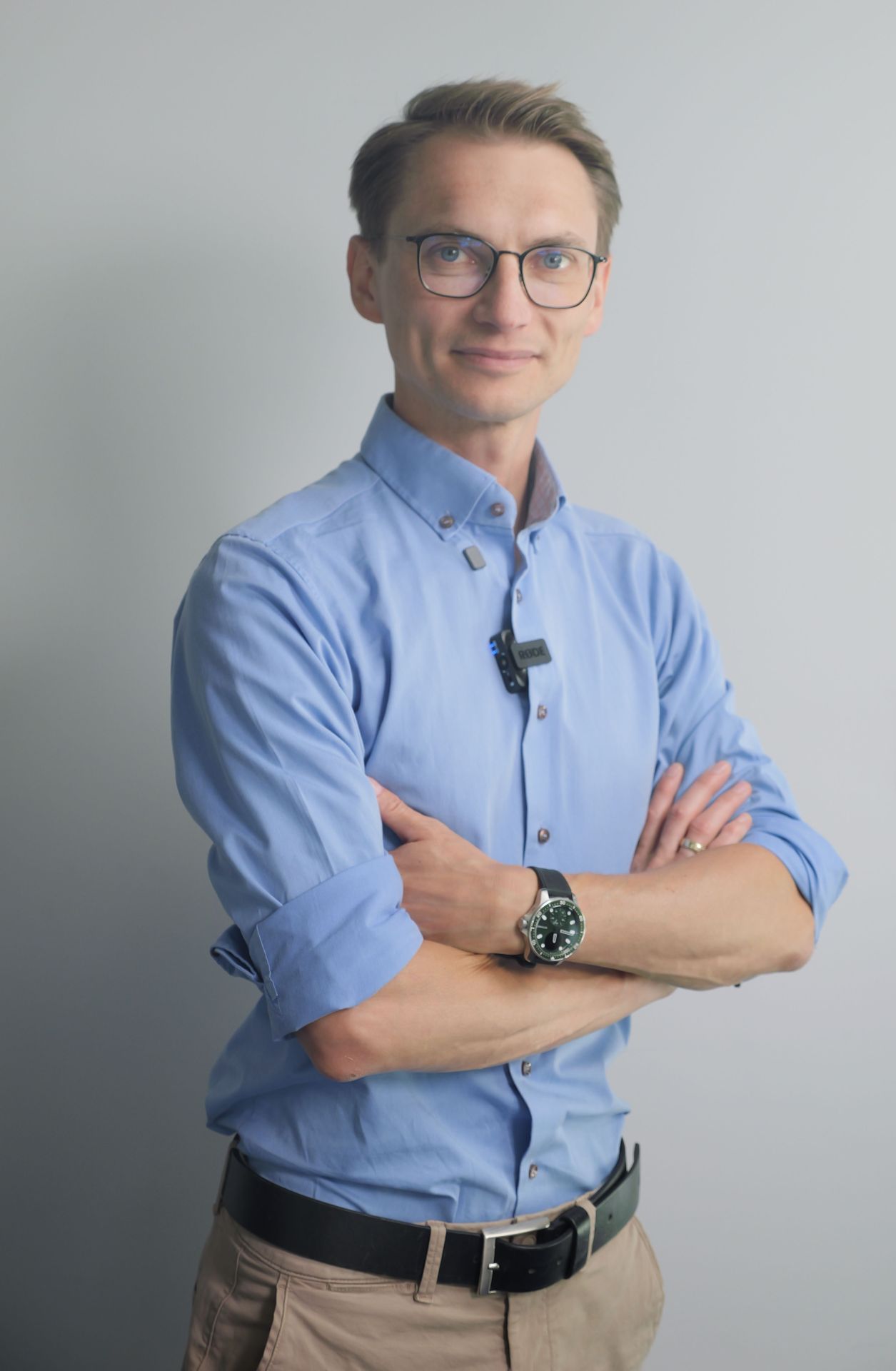
Marcin Tuszkiewicz
CEO
Squaber.com
Have a topic? Let's talk!
At Euvic Talks we meet people who act, not only talk. Write if you have an idea for an episode.