Losing users? Maybe your design is excluding them | Michał Popiel, Head of UX/UI | Euvic Talks
Many entrepreneurs treat UX and UI as an “aesthetic add-on.” Meanwhile, design mistakes can cost you up to 30% of your potential customers. In the latest episode of Euvic Talks, Michał Popiel (Head of UX/UI at Euvic), an expert with experience at JP Morgan and Goldman Sachs, reveals how to turn design into real profit and savings.
In this episode, you’ll learn:
- Why digital accessibility is a business necessity, not just a legal requirement.
- How to avoid “burning” your development budget through product workshops.
- What a Design System is and why Michał compares it to Lego Technic blocks.
- What the differences are in design approaches across the US, Europe, and the Middle East.
- Whether AI will replace designers and where modern Product Design is heading.
👉 And if you want to better understand your users and test our way of working – we invite you to join our product discovery workshops. Just fill out a short survey: https://cy7qux.short.gy/ankieta-iwp
Bartek: Hi, I’m Bartek Śliwa. Welcome to another episode of the Euvic Talks podcast, where we bridge technology and business. Today, we’re going to focus on product design in a broad sense, and my guest is Michał Popiel. Hi, Michał.
Michał: Hi, Bartek. Glad to be here.
Bartek: Michał, the standard opening question of this program is always about your business history. I know it’s international and has involved some of the world’s biggest financial giants. So, tell us briefly about yourself—what did your career path look like?
Michał: Well, in short, it’s one big accident, like everything else in my life. A long, long time ago, I studied at the Academy of Fine Arts and specialized in furniture making, which remains my main passion to this day. I was working for an advertising agency as an Art Director and Creative Director when, one day, the phone rang. It was a total fluke—someone dialed the wrong number and missed the last digit. I was offered a job as Head of UX for one of the largest investment banks in the world. I thought, “Why not?” and that’s how it all started. I went through 12 or 13 rounds of high-level interviews—MD and even C-level. Later, I admitted it was all a bit of a fluke, but they said since I passed all those stages, I was clearly the right fit. And as it turns out, I was. I stayed in the profession, and it taught me a lot. Working for such massive corporations teaches you a different approach, where you constantly balance cost and profit when it comes to design.
Bartek: Okay, can you reveal who those big players were?
Michał: Yes, that would be JP Morgan—I always praise JP Morgan; it’s a great company to work for, other than Euvic. Also Morgan Stanley and Goldman Sachs—the “holy trinity” of investment banking. I’ve also worked for BNP Paribas, Saudi Arabia British Bank in Riyadh, and several other smaller investment banks that invest in places like Africa, Central Europe, or Eastern Europe.
Bartek: Did I understand correctly that your first position in product design was immediately a leadership role? Head of UX for JP Morgan?
Michał: Yes, straight into the deep end. I had to build teams, which I grew from four people to over 300 within the first three years.
Bartek: Okay. So, what’s the difference between being a Head of UX or Head of Product Design in those massive financial firms versus an outsourcing company like Euvic?
Michał: Honestly, every company has the same core elements: maintaining quality, selling that quality, evolving, and creating products. Based on those basic principles, it’s practically the same. What changes is the project duration and the budget. Investment banks invest in themselves, so those are huge budgets planned for the very long term. Euvic has a different formula—we work for clients, so optimizing the offer and working faster is extremely important.
Bartek: Were there any key projects in your history that shaped you as a designer and a leader?
Michał: Definitely, especially the projects I’d categorize as “black magic.” These were projects I knew nothing about at the start and had to learn from scratch. They helped me form my own theory—the “Black Hole Theory.” I go into projects I know nothing about and accept the fact that I don’t have to know everything yet. Through workshops and my own research, I slowly dig up the information I need until things start to click. There’s a moment in a designer’s work where something just “clicks,” and that’s when you become highly productive. But before that, you must give yourself the time to understand the subject. It’s crucial to give a designer the space and the material to understand the topic so they can create a meaningful interface that serves the client properly.
Bartek: That makes me wonder—how do you provide that space and creative freedom at scale? How do you build that design culture within a team of designers?
Michał: Designers are sometimes delicate creatures; they have artistic souls. But UX, for example, connects that with technology—it’s a crossroads between developer-style thinking and a strong creative direction. A good designer needs a creative buffer around them. You have to find a balance between “let’s do this faster” and “let’s do it right,” while ensuring there’s time to learn. So, it requires a lot of individual treatment depending on the person’s character. You talk differently to different designers or groups.
Bartek: In your opinion, what is—or should be—the hot topic right now for companies and people building digital products?
Michał: Definitely understanding a broader pool of customers—specifically, accessibility principles. One regulation I actually like, which the EU and the US are mandating, is treating people equally and making companies aware that not everyone perceives products, apps, or websites the same way. We’re dealing with—I don’t like using the word “disability”—but different ways of perceiving reality and different physical mechanics in how we use computers or hardware. This should be a top priority right now. If the world is moving toward “let’s all understand each other and do no harm,” design should reflect that.
Bartek: Do you see any specific business benefits for companies in this?
Michał: Massive benefits. We don’t realize that 20% to 25% of people (and this is a growing trend) will encounter some form of accessibility issue in their lives. Whether it’s a motor issue—like not being able to use a mouse or having shaky hands—or a cognitive issue like dyslexia, or even something we often overlook, like not seeing the full color spectrum. By ignoring this, you exclude 20%, 30%, or sometimes even more of your customers from using your product. And a 20% to 40% market share is huge.
Bartek: So, if the increase in potential users isn’t a convincing enough fact, you also mentioned regulations. Ethics, morality…
Michał: Regulations are one thing, and money is another, but there’s also moral responsibility. We all want to do the right thing and have an impact. We’ve had philanthropy for years. Investing in accessibility is, in a way, “digital philanthropy”—showing that we care. It shouldn’t just be about whether a company has a specific budget for it; it should be the foundation of how we think. A great example is companies like TripAdvisor or other travel sites. Initially, blind people or those with other challenges couldn’t use them at all—yet blind people want to go on vacation too, and they want to book it online. One such site invested significant money into this, and it paid off within a year. Suddenly, everyone with vision or cognitive challenges started booking vacations exclusively through that site. Their turnover increased dramatically.
Bartek: Those are great examples of why it pays to be a pioneer in something people talk about but don’t always practice. How does the approach to accessibility differ between countries? You’re working from Poland now, but you’ve worked in the US, UK, and Saudi Arabia. Is the approach consistent?
Michał: There are differences. In the United States, morality has started to play a big role now. Previously, it was regulation that “taught” us morality—basically, heavy fines. Companies started talking about it and seeing the problem, effectively recognizing their mistakes. It wasn’t just “we were fined, so we have to do it,” but rather the financial penalty led to a genuine understanding of the issue.
Bartek: The fine was a pointer.
Michał: A pointer, exactly. A “nudge” from the government. In Poland, we still have a bit of a dismissive attitude toward regulations; we don’t always follow them. However, companies with a broader customer base are seeing the issue. But it’s also up to us, designers and companies like Euvic, to promote it. Until you see the problem, you don’t realize it exists. It doesn’t make you a bad person or a bad company; you just haven’t thought about it. It’s a learning process. Just like learning something on YouTube—I see a cool video on how to build furniture, and I learn it because I didn’t realize it was that simple. Accessibility is the same. It’s not rocket science; you just need to learn the rules.
Bartek: Following that, I wonder how much the cost of developing a digital product increases if we want it to meet all accessibility standards?
Michał: In my opinion, it might slightly increase costs at the very beginning due to audits, but that cost levels out very quickly, and you start profiting from those changes almost immediately. I see it like a ticket to a great event—you pay the cost upfront, but the experience stays with you and changes you. It can change how a company operates and significantly boost revenue. Properly implemented accessibility has a very positive impact on the bottom line.
Bartek: How would you classify which projects should meet these accessibility standards? It seems obvious for products with a wide audience, but what about internal systems?
Michał: Regulation helps us here because it doesn’t demand the same level of strictness for everything. Regulators realize you can’t do everything at once, so there are different levels of accessibility: Single A, Double AA, and Triple AAA—the latter being the gold standard. Government sites often meet these, which requires removing “noise”—reducing the number of elements on a page. Government sites are a good example: lots of text, very well grouped. Information architecture is a key element—arranging info so it’s easy to access. I have an example from my life: at JP Morgan, we had several older traders. One was over 70 and starting to lose his sight. The systems with clicking, moving numbers became a problem for him, but he loved his job. JP Morgan respects its long-term employees, so I was asked how we could improve his workflow through accessibility. We tried many things, but due to the complexity, we couldn’t solve it all digitally. We solved it a different way: we hired an assistant for him to read out the numbers. I say this because not everything can be solved with code. Sometimes you have to think logically and practically: cost vs. gain. You have to try.
Bartek: I’d like to go back to your international experience. What stands out to you about the different regions you’ve worked in?
Michał: Poland is a very demanding country. Companies have huge expectations, though they don’t always have the knowledge to ground those requirements. Western companies tend to trust firms like Euvic more. In the US, there’s a lot of trust in experience—even top executives realize they don’t have all the answers, so they trust the experts they hired. Saudi Arabia has a lot of micromanagement, but also a lot of trust in designers. There are differences everywhere, but in all these countries, User Experience is recognized as a key element. In Poland, people used to think of it as just graphic or web design—”make it colorful and it’s great.” Now, the approach has become more systematic. There are cultural differences, but the technical, professional standards are quite similar.
Bartek: I always like to emphasize that a product designer’s work before coding even starts saves a lot of money.
Michał: Absolutely! Workshops, workshops, workshops! It used to be “just make me a site that looks pretty,” and that was the whole brief. Now, we hold workshops. Their power is often underestimated, but the savings are massive. It started with Toyota and their production lines—optimizing work not to punish employees, but to notice unnecessary steps. Workshops do the same: talk to the client about how they work and how they could work. Present it visually, because numbers don’t speak to everyone. If someone shows me a flow, I can quickly see the difference and identify the profit.
Bartek: Speaking of workshops—you can find a link to a survey in the description. Fill it out, and we’ll contact you within 24 hours to discuss your product and how workshops can help. Michał, what kind of workshops are we talking about?
Michał: It’s important to look back at my experience in investment banks where I learned to work less conventionally. We have a whole range of workshops, but that doesn’t mean we use them all. Sometimes, for a quick “discovery,” we skip elementary steps because a designer can make certain assumptions based on experience. After years in the industry, you see patterns that link all projects regardless of the company type. I combine workshops to satisfy the client without losing quality. You have to talk openly about expectations. For me, it’s vital to describe exactly what will happen in a workshop when I send an invite. It makes the client feel prepared. A good designer knows which workshop is needed but also knows when to back out of something that isn’t providing a benefit. There’s no point spending three hours building a persona if there’s only one type of customer.
Bartek: So the right approach is picking the right “blocks” from the set and staying flexible?
Michał: Yes. And sometimes you have to deal with skeptical clients. You start with easy tasks to spark creativity. We recently had workshops with a large bank that had never done them before. We started with seemingly trivial tasks, and halfway through, the client said, “I love this!” Now, every workshop with them is a pleasure because they feel involved. That’s crucial—the client shares their experience; they are the company. Without them, we can’t build anything. I couldn’t build a good interface without a workshop phase because I have to understand these people.
Bartek: Okay, we’ve covered accessibility and workshops. Something designers talk about a lot is a “Design System.” What is it, and why should a client invest in it, especially since they usually want to pay for “finished screens” rather than a system?
Michał: Again, it’s about how we present it. A Design System is a cost-saving tool. Often, several designers work on a project, or people rotate. A Design System guarantees consistency. It’s like the foundation of a building—without it, the building collapses. If you build a house by just “winging it,” you’ll end up with a Quasimodo. A Design System defines exactly how everything should be built. Think of it like Lego Technic. Try building the Titanic out of 40,000 pieces without an instruction manual. You might end up with something that looks like a boat, but with the manual, it’s almost guaranteed to be great. It defines fonts, colors, brand, and interactions. It keeps us grounded—it stops designers from going rogue. As creative people, we love to “fly off,” and this keeps us systematic. It’s a mix of business and creativity.
Bartek: So it’s not just a manual, but a way to limit the toolbox so creativity doesn’t wander off into the weeds?
Michał: Exactly. But a Design System isn’t a Bible that never changes. You can do “design challenges,” communicate changes, and test them. Importantly, a Design System is like Legos. If you decide a yellow brick in your Titanic is bad, you don’t have to tear the whole thing down. You replace that one “brick” in the system, and it updates everywhere automatically. You save hours of work. In advanced trading systems, projects that would take one year could turn into 15 without this. It protects us from chaotic external changes.
Bartek: How do you see the future of product design regarding accessibility, systems, and AI?
Michał: AI is an interesting topic, but it won’t replace that spark of creativity. We’ve all used AI and noticed that the answers can be stiff and don’t always meet our expectations. Designers are safe for many years. Design is always evolving. What we thought was the “endgame” is now just the beginning. We used to make sites where everything jumped and clicked. Now, I see design moving toward simplification, clear communication, and building emotions that support our goals in a less visually stimulating way. We’re striving for simplicity because our world is getting complicated. We’re overwhelmed by notifications and screens. Designers are starting to cut out unnecessary elements through “informed decisions.” We also have to consider the environment—what else is the user seeing on the screen next to them?
Bartek: How are we preparing for this right now?
Michał: Keep your eyes wide open. If someone says accessibility is important—listen. If workshops are important—listen. Think of technology as a friendly element, or other companies will overtake you. UX has taken over everything. People used to say “nice graphics,” but now everyone knows UI and UX. Interfaces in cars, watches—it’s all based on these principles. We, as advocates, should promote this. UX is a career you can transition into—it’s not “simple,” but it’s worth it. Or, just wait for a phone call where someone dials the wrong number, like I did.
Bartek: You trust in luck and chance in your life.
Michał: I do. When a problem arises, I don’t panic; I just let myself think it through calmly. You don’t have to know everything immediately. That’s what workshops and research are for. UX is a job where you never stop learning—not just about design, but about the world. I learned about finance to the level of understanding exotic options, which gave me a perspective on how the financial world works.
Bartek: Final question: what has inspired you lately? A book, a movie, an experience?
Michał: TikTok.
Bartek: Expand on that.
Michał: TikTok and the algorithm that tries to understand me. It’s strange—I used to be against wasting time on screens, but now it’s one of my biggest sources of inspiration. It shows that you shouldn’t be stubborn. At first, TikTok gave me “cats and dogs,” but now it gives me content I’m actually interested in. Inspiration changes constantly. If you have an open mind, you can translate ideas between professions. I make furniture in my spare time—it teaches me precision, tool selection, and finding better ways to do things. A Design System is precision. A workshop is thinking through why I need a piece of furniture and where it will go. I’ll build a kitchen out of cardboard before I spend money on it. The McDonald brothers did the same thing—they drew the kitchen layout on a tennis court and had employees run around to optimize the flow. Those were the first steps of UX, before it even had a name. Keep an open mind about life in general, because it will impact your profession.
Bartek: Great, thank you so much for today. And thank you all for watching and listening. Join us for the next episode of Euvic Talks. Thanks!
Michał: Thanks.
Meet our guest
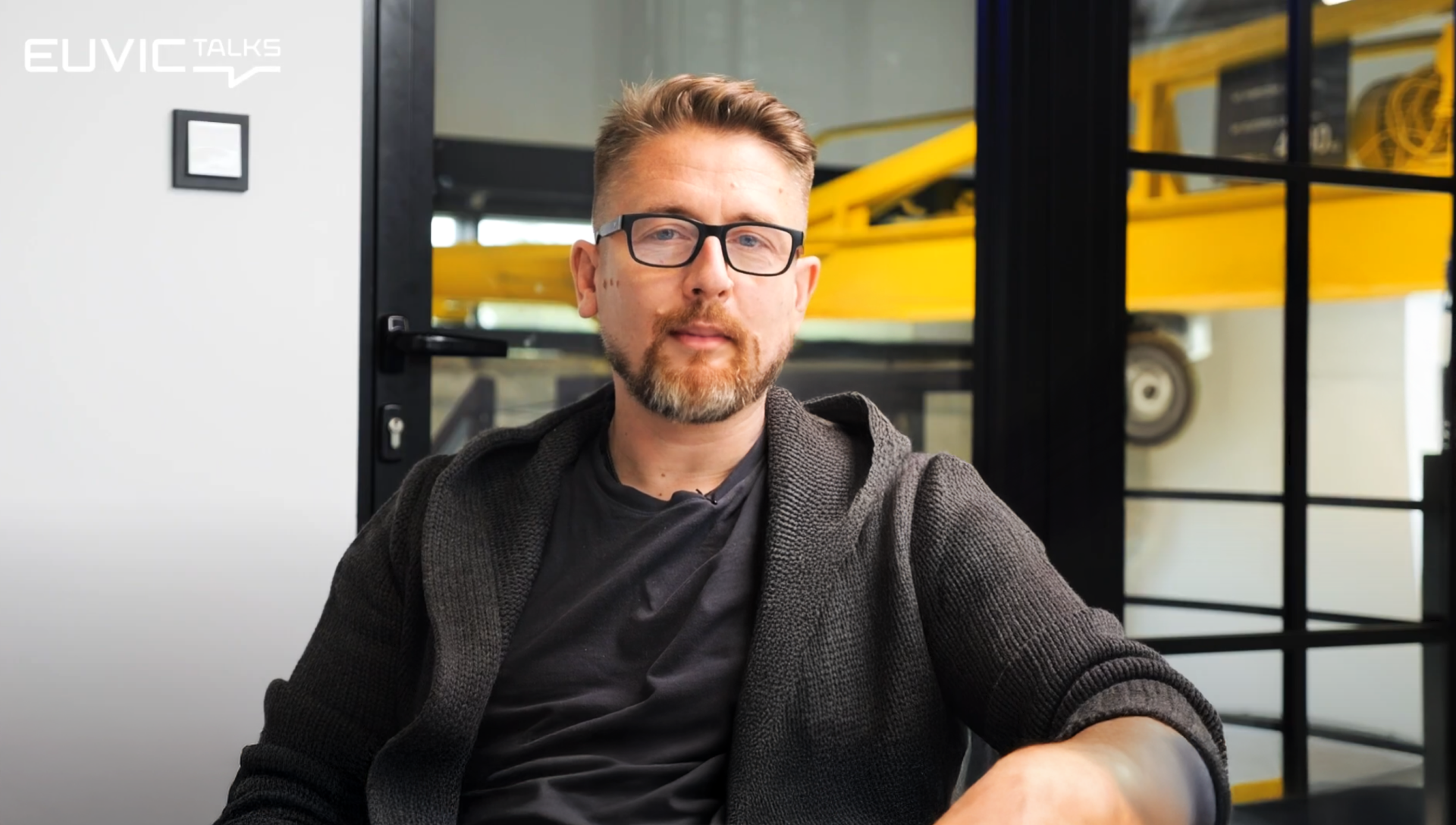
Michał Popiel
Head of UX/UI
Euvic S.A.
Have a topic? Let's talk!
At Euvic Talks we meet people who act, not only talk. Write if you have an idea for an episode.