Procedure Over Error: Lessons from MilTech | Jakub Kurdybelski, CEO Adapt-E | Euvic Talks
Modern warfare is largely a battle of algorithms and information filtering systems. In the latest episode of Euvic Talks, Jakub Kurdelski, an expert with 15 years of experience in the defense industry, reveals what goes on behind the scenes of designing military systems. This conversation is not only about military technology, but also about universal principles of building reliable products (Life-Critical Systems).
Key topics:
- Managing uncertainty: The military approach to emergency procedures as a model for business stability.
- The UX paradox: In the civilian world, we aim for convenience. In the military, Jakub designs systems that replicate harsh conditions (tight spaces, noise, darkness) to ensure realistic training.
- Scaling innovation: How Polish MilTech companies build competitive advantage in international markets and why decision-making time in the military can be critical for small businesses.
- The evolution of AI: The shift from pure hardware to intelligent IoT sensors that help commanders separate signal from noise.
Bartek: Hi, I’m Bartek Śliwa. Welcome to another episode of the Euvic Talks podcast, where we bridge business and technology. Today, we’re combining business, technology, and defense. My guest today is Jakub Kurdelski. Hi, Jakub.
Jakub: Hi, great to be here.
Bartek: Jakub, to start off, we’d like to introduce you to our audience. Tell us a few words about yourself and what connects you to the world of business.
Jakub: You combine business with technology; we combine adaptation with engineering. What connects us to business and tech is the fact that we build solutions for the military. That is our main specialty. Personally, I’ve been working with the military for about 15 years. I’ve worked for the largest Polish defense companies, but right now I’m focusing on developing my own company, which is focused on innovation and R&D, specifically for the defense market.
Bartek: 15 years—that sounds like a lot of experience. And yet you went through it so quickly.
Jakub: You know, it’s a very diverse environment that provides a lot of experience, different projects, and various perspectives. There was a moment when I pivoted and decided that the military wasn’t for me anymore, so I went to a corporation to work like “normal people.” I started working on projects where people had been doing the same thing for 10 years. I quickly realized that wasn’t for me. I need frequent changes and the thrill of creating things that don’t exist yet—things you have to reinvent from scratch. This industry allows for regular project changes and a breath of fresh air. One day we’re doing image analysis, then we jump into AI, then lidar technology, or SAR. There are so many topics to verify for clients. Plus, you have to stay on top of tech novelties that might be useful in the future.
Bartek: We’ll get back to that because one of my questions will be about how fast the military keeps up with change, but let’s save that for later. First, I want to ask: does military equipment even work without software today? What is the balance between hardware and software?
Jakub: I think we’ve completely moved away from hardware that works without software. We no longer have PCBs with just logic gates doing the job. Every time we design a PCB, there’s a microcontroller that needs programming. That’s just reality now. Is software more important? In a sense, yes. It can also have many vulnerabilities, which makes it critical. A good example is modern military aircraft. When talking about fifth-generation fighters like the F-35, it’s widely known that its software is so advanced that its Kill Ratio compared to an F-16 is 1 to 20. This means one F-35 can take out 20 F-16s simply because it has newer software and greater capabilities. Of course, hardware and software go hand in hand, but software is so vital that without it, we can’t do anything anymore.
Bartek: That’s fascinating—one plane versus twenty really shows the advantage. Any other examples?
Jakub: Everywhere where you can detect an enemy instantly. I remember once we were conducting flights at a range with the military. The soldiers had deployed their units, set up a command vehicle, and hidden in the woods. We were flying a drone over them equipped with day and thermal cameras. At one point, the colonel said, “I wonder how fast you’ll find us.” All we had to do was switch to the thermal camera, and we saw everything clear as day. So, to the question of whether we can mask or hide a heat signature—research is being done, but for now, thermal imaging very clearly shows where the enemy is. It’s a massive technological leap; those capabilities didn’t exist before.
Bartek: So all those headlines about new equipment providing an incredible advantage aren’t just myths?
Jakub: They aren’t myths. Look at the Iron Dome in Tel Aviv, used to defend against incoming missiles. It’s a massive boost to defense and protection. But on the other hand, since our solutions are much more accurate and precise, the attack can be more targeted. My former CEO used a phrase I liked: we no longer have to send in artillery and level an entire city because we know the command center is in a specific spot. We can perform a “surgical” operation. We destroy a specific unit instead of destroying everything. It’s a combination of intelligence, modern technology, and guided missiles.
Bartek: I’m trying to draw conclusions from what you’re saying. Briefly: does the fact that Russians often miss their targets and fire broadly stem from their nature or from old equipment?
Jakub: You can’t answer that briefly. It’s complicated, and they probably wouldn’t give a straight answer themselves, so I wouldn’t want to be in their shoes. Some will say one thing, others another. Certainly, some of their solutions are very modern. Russia invests a lot in the military. Usually, it was an investment in quantity over quality, but training is also key. In NATO, we place a huge emphasis on training the individual unit. You have to remember: if you give a soldier modern equipment, they won’t use it effectively without precise training. That’s why we focus so much on training—to prepare the soldier for what might happen on the battlefield. In normal training, if a soldier makes a mistake, it’s part of the learning process. In combat, one mistake means death. We put massive pressure on making sure our soldiers are as prepared as possible.
Bartek: What does the local Polish market look like? Do we create our own solutions, or do we implement others’?
Jakub: I’d like to say we create our own, because there are many companies doing innovative work. Unfortunately, we borrow a lot from other countries. We often have a requirement to “Polonize” foreign solutions, which I think is good because it helps the soldier adapt faster to a solution customized for their needs. Nonetheless, we should focus more on innovation and look for solutions in our own market, supporting local companies. My company is a good example—we mostly work with the foreign market rather than the Polish one, even though we make things that would be very useful for the Polish military.
Bartek: Here’s a shout-out to the Polish military: write to Jakub! Kuba, tell me more—I know you’ve also had experience with MedTech. Could you touch upon that?
Jakub: Those fields are actually very related. Let me go back to my corporate days. I worked for two corporations, and each had a different approach. The first put a huge emphasis on production quality—no mistakes allowed because the solutions were meant to work for 20 years from the moment they were plugged in (heavy industry, production lines). The second company was focused on “time to market,” so we had to be as innovative as possible. If production errors occurred, we had SLAs to meet. It wasn’t a tragedy—maybe a marketing embarrassment, but not a disaster. In MedTech, if a sensor or device fails that is responsible for maintaining human life, that’s a massive problem. It’s the same with the military. If a failure happens during training, that’s fine; we work with the client through the implementation phase. But once it hits final production, goes into a military warehouse, and is ready for a “Scenario W,” it must be 100% reliable. Lives depend on it.
Bartek: What did you learn from working on such Life-Critical products?
Jakub: Primarily, to help the end-user. I’m not just talking about functionality, because for me, quality is a given—it’s the standard. But what I often lacked when working with the local military was extended contact with the end-user.
Bartek: By end-user, do you mean the operator?
Jakub: The operator. Not the manager who orders it, not the person who accepts the delivery, but the person who actually uses it. Sometimes we had to hide the fact that we were helping users build a specific function they actually needed because, theoretically, we were supposed to stick to the basic requirements in the contract—even if the user said they didn’t need that anymore because they had verified the equipment and saw a different need. That’s why I have a bit of a problem with innovation in this setup. Innovation used to come from the military; now I feel it’s often the other way around. In “time to market” industries, you release something fast, get feedback from thousands of users, and know what to fix. In a Fix Price contract where contact with the end-user is limited, innovation and fixes take much longer. You have to fight to make them happen, even though they should be a natural part of any contract.
Bartek: So, how do you design solutions when lives depend on the decision?
Jakub: The main focus has to be reliability. It has to be “idiot-proof.” A person under fire needs to be sure they are plugging the right connector into the right socket. Every electrical harness has to be made with a different military-grade connector so it’s impossible to plug it in wrong. We put a lot of emphasis on making it universal, durable—you should be able to drop it in the mud, step on it, and it should still work. At the same time, we fight to make it as light as possible because a soldier has to run with it on their back. It’s not easy when people are jumping out of planes with full gear, trekking 20 km to perform a mission, and then extracting.
Bartek: Sounds like a challenge. Moving on, I’m curious how you manage military-related projects. You mentioned returning to MilTech for the change and new projects. How does “Agile”—which is so common in software development—look in this world?
Jakub: I try to introduce agility. I’ve worked through many methodologies, from classic management to very agile ones. You have to find a balance because Polish tenders are often limited in time, budget, and scope—typical Fix Price. The challenge is manipulating the scope in a way that doesn’t compromise quality but still delivers functionality the user is happy with. For example, I once created a training solution. We had an unlimited budget initially—that was the plan. We listed all the features and did the quote. After negotiations, we had to lower the price. Then it turned out we either wouldn’t deliver or we’d have to do it at minimal cost. We chose the latter. We cut costs 15-fold. Instead of an entire training room, we built portable gear with software that could plug into a physical station. Time showed it worked. That gear is still used today. I teach my team to decompose tasks so we can deliver value by doing less but maintaining the core functionality. This is a universal problem: dev teams always want to improve things endlessly, but often the solution is already “market-ready.” You can deliver an MVP—it doesn’t always work like that for the military, but you can still build things that provide real value.
Bartek: I was trying to figure out the real constraints in this industry. Is it the budget?
Jakub: The main constraint seems to be time. Regarding innovation, we lack tools that specifically support the military innovation market. The time for implementation and negotiation is so long that a company waiting on that one client might go under. In Poland, there are only one or two users. If negotiations take three years, they can kill a business before the first installment is paid. So, budget matters, but the delay is what’s lethal. When there’s an urgent need, like in Ukraine, money appears quickly. If we’re talking about “nice-to-have” solutions, the decision often comes too late. I once worked for power plants—a power outage is a tragedy. In medicine, a lack of equipment is a tragedy. In the military, if we don’t get tanks this year, maybe we’ll get them next year. That ability to delay decisions can cost small, innovative businesses a lot.
Bartek: Kuba, let’s move to what you’re currently doing: military simulators. My first question: can simulators replace the training ground today?
Jakub: Replace it completely? No. But partially? Yes. It can’t eliminate it, but it can take over, say, 50% of the training. The advantage of a simulator is that we can show all the errors and failures. If there’s a fire in a tank, we can simulate how to use the extinguisher, where the switches are, and the reaction time. You won’t shoot at a real tank just to show a user how it reacts. A good example is flight simulators, where experienced pilots spend 90% of their time flying with a simulated failure. The goal is to get the user used to analytical thinking under pressure. People in stress often get tunnel vision. For example, during first aid, someone might see cardiac arrest and start CPR, not noticing the person has a severed artery and is bleeding out. We try to teach rapid analysis schemes before a decision is made. Simulators allow you to practice rare situations ten times over so that in reality, you act on instinct. I have a memory: when I became a lifeguard and had first aid training, I witnessed a real accident. My friend and I—both certified—totally froze. We were stunned. Despite our training, we didn’t know what to do. With regular, repetitive simulator training, you don’t have to reach into your conscious memory; you act instinctively.
Bartek: The military is growing, and instructors say there are only a few of them for a thousand users.
Jakub: Exactly. They need solutions that allow soldiers to sit down and remind themselves how the equipment works without destroying expensive, real hardware.
Bartek: You mentioned AI in the military. That seems to clash with the idea of AI being unreliable. Where does AI fit in an industry where there’s no room for error?
Jakub: AI can assist us, but it shouldn’t replace us. It works great for image analysis—helping a user detect if a vehicle is a friend or foe—but the final decision must always be made by a person, whether it’s a pilot or a commander. Currently, the battlefield is overwhelmed with information from sensors and IoT. AI can pick out the most critical data and draw the user’s attention to a specific parameter that is behaving strangely.
Bartek: I’m curious about how you design UX for such solutions.
Jakub: In the military, UX is extremely important because things must be intuitive and not cause accidental consequences. You can’t have an accidental magazine release because of a button placement. On the other hand, in simulators, we have to reflect reality, even if it’s inconvenient. If a switch in a tank is in a hard-to-reach place, we leave it in a hard-to-reach place. If the environment is dark, cramped, and loud, the simulator has to be dark, cramped, and loud. A soldier sees the world only through small periscopes; they don’t have a sense of what the vehicle looks like from the outside. If they hit something in the simulator, they learn so they don’t do it in a real command vehicle.
Bartek: It’s the first time I’ve heard of an industry where UX must be intentionally difficult.
Jakub: We can’t lie about reality. That’s the difference between a simulator and GameDev. In games, it’s supposed to be pleasant; for us, it has to be like real life. I remember showing a tank simulator at a trade show. People immediately asked where the “shoot” button was. But you have separate roles: the driver, the loader, the gunner, and the commander. It’s not “World of Tanks.” You drive, and you have to cooperate with the rest of the crew like a single organism.
Bartek: Kuba, what can business take from the military?
Jakub: Business has been taking from the military for years—the internet, rockets. The military used to be the most innovative. Today, I feel it’s going the other way—the military is taking “time to market” and innovation validation from business. As for uncertainty: I once did a demo for a foreign client. Our gear broke, a drone crashed. For us, it was an embarrassment. But the client wrote in their feedback that the problem wasn’t the accident; the problem was that we didn’t have a prepared procedure for when it happened. The question is: how much does business think about risks and procedures for when things go wrong?
Bartek: To wrap up, what has inspired you lately?
Jakub: I find it very inspiring to see young people on LinkedIn who are coming up with solutions in their garages. We should support young innovators. Innovation starts in the way you think, not just in big companies and big money. These people will be very valuable employees in the future.
Bartek: Great message. Thanks, Kuba, for today’s episode. Thank you all for listening, and see you in the next episode of Euvic Talks.
Meet our guest
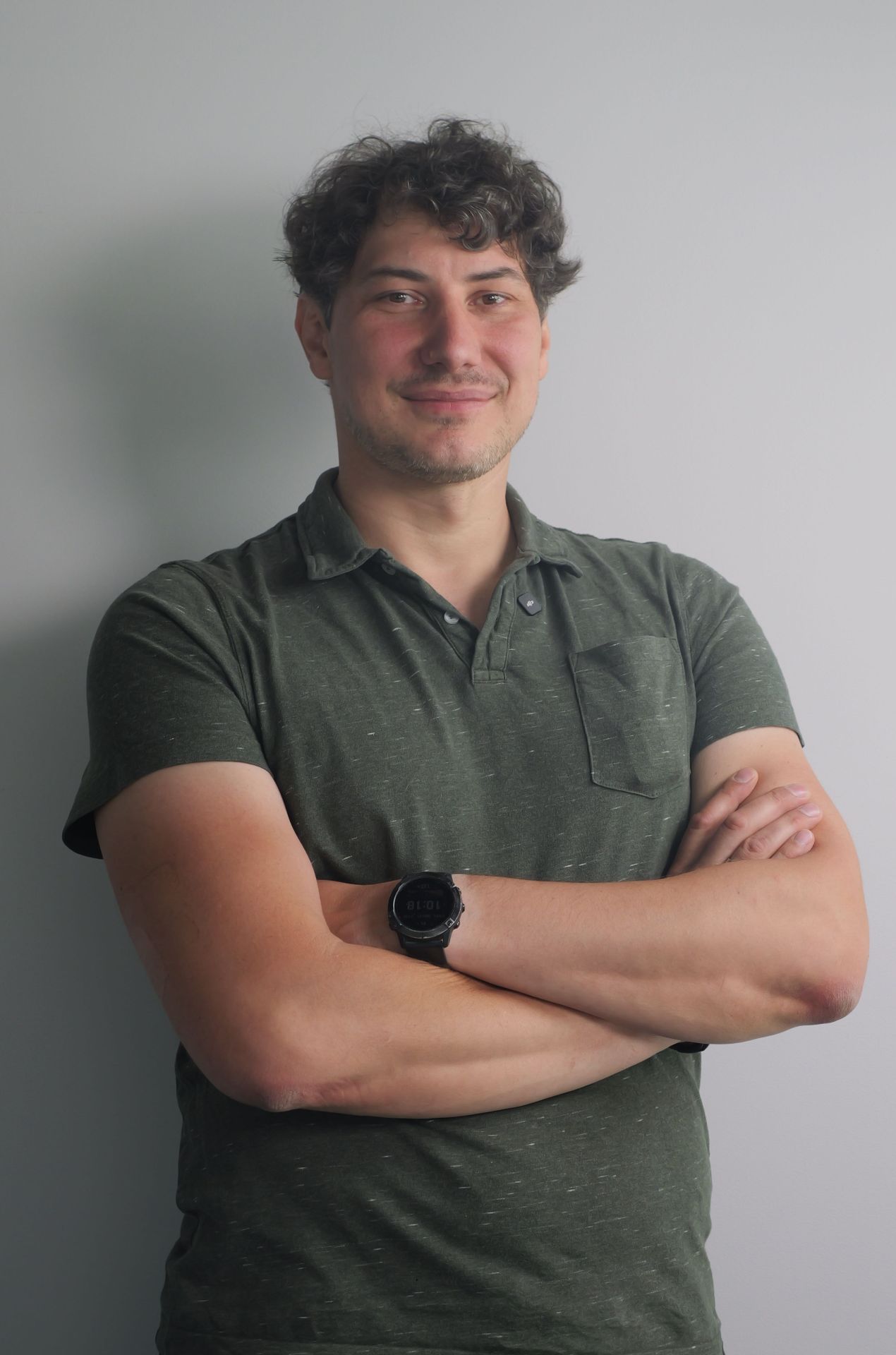
Jakub Kurdybelski
CEO and R&D Director
Adapt-E
Have a topic? Let's talk!
At Euvic Talks we meet people who act, not only talk. Write if you have an idea for an episode.