- how to recognize when a company is ready for ERP,
- how to choose a system that fits both current and future needs,
- where to draw the line between standard functionality and customization,
- why ERP implementation shouldn’t be left entirely to the IT department,
- how data quality affects the use of AI in ERP systems,
- which common mistakes make implementations more difficult or cause delays.
Bartek: Hi, Bartek Śliwa here. Welcome to another episode of the Euvic Talks podcast, where we connect the worlds of business and technology. Today, we’ll talk about leveraging technology to manage organizational resources in a broad sense. And we’ll be talking with Marta Osiak. Hi, Marta.
Marta: Hi, Bartek.
Bartek: Before we get into the meat of our episode, I’d like to ask you, as is our custom, about your business journey,because it’s quite impressive. From consultant to director, with a CEO role along the way, and now you’re with us at Euvic. Tell us what that path looked like, what key decisions you made along the way, and how your perspective on implementing ERPs changed depending on the role you held.
Marta: Well, I started practically right after college thanks to my first boss as a consultant. At first, a typical helpdesk service type, and in that initial phase, I got to know the solution because I focused exclusively on Microsoft solutions—then Dynamics NAV, today Microsoft Dynamics 365 Business Central.
And then I continued that path as an independent senior consultant in other areas, more of an implementation consultant.In my first company, I actually held that role for about 4 years up to senior consultant in various scopes of responsibility.At first, it was service work, direct customer support, and then independent implementations related to the automotive industry. So, end-to-end from the very beginning up to end-user support through testing. The only thing I didn’t do was programming, because that work was strictly about working with both the client and the developer.
And then I changed jobs and joined AP, also as a senior consultant, but there my path unfolded very quickly. I joined as practically the sixth person in a tiny department that served only one client. There, we managed to grow that organization through organic growth, but also acquisitions, up to 160 people.
My last position there was managing the entire organization and having an impact on it. I won’t deny that halfway through that 15-year period, I made a decision on whether I wanted to go down the specialist path or the management path. I think naturally—maybe not easier, but internally—it was easier for me to manage, even though I didn’t completely lose my love for the system. To this day, I hold it in high regard and it always gives me pleasure to work with it as a board member.Working with this system is just intuitive, easy, and I simply trust it. So that’s how it looked over the years. And now at Euvic, I’m building this path and capabilities from scratch.
Bartek: I’d like to go back to AP, because scaling something from six to 160 people is an interesting case. You mentioned there were mergers along the way. Can you share some interesting stories or takeaways from that period?
Marta: A highlight for sure—and something that gave me internal satisfaction—was that history came full circle at AP.Practically along the way, together with the owner, we were buying companies where my acquaintances actually worked—people I had met on my path.
One of the companies we merged last was Alna Business Solutions, which was actually the company where my career had paused earlier, and where the same people who remembered me as a junior consultant were still working and sharing their experience.
I won’t lie, I think it worked out for me because turnover was remarkably low, and we managed to pass that DNA on to the new companies without disturbing the model they worked in, as those models were working well. Because of that, we scaled nicely, acquired new clients, and gained specialists, because there was—and still is to some extent—a shortage of Microsoft Dynamics specialists on the market.
Bartek: So those mergers were also heavily relationship-driven, as I understand?
Marta: Yes, absolutely relationship-driven.
Bartek: Okay. And tell me, how do you step into the CEO seat in all that chaos—not chaos, but generally a complex environment—where, as you mentioned, you merged four companies along the way? You didn’t land in the CEO seat right away, so I assume something must have happened along the way for you to end up there.
Marta: Yes. I think my former boss made the final decision around the time of the first or second big merger, when a group of 60 people joined.
Bartek: And how many people were in the company at that point?
Marta: At that point, the company had around 90 people, because there was one small acquisition before that and two small ones later. And it worked out, because we kept practically 100% of the people on board. That wasn’t the goal in itself, of course, but along with that, we adjusted the structure and reorganized because the organization required it. We raised the quality of service for clients, those clients stayed with us, so I think that was a big success.
It happened during a challenging or specific period because I also became a mother right around that time, if I may share a bit of personal detail. So certainly not an easy period, but despite all that activity, upon returning to the organization, I received the proposal to take on the CEO role.
Bartek: So did you aspire to that role yourself, or was it offered to you?
Marta: No, it was offered to me. The fact that the owner had been talking about it for some time was finalized when I returned to the organization after maternity leave. It’s a nice story, a supportive one regarding women, because maternity leave is viewed differently by owners in different organizations.
Now, moving on to ERPs, could you explain what ERPs are and when an organization actually needs them, versus when it can still do without them?
Bartek: What are ERPs? In the past, we probably would have said it’s a system. Today it’s still a system, but we talk about it in a somewhat broader context. We no longer talk solely about its functionalities or a specific software installation. The decision to implement an ERP in an organization is no longer strictly an IT department decision, as it used to be.
Today, we talk about ERPs in the context of business benefits and change. ERPs function differently today—besides being supported by artificial intelligence and having AI agents, it’s software that supports business decisions and allows them to be made quickly across sales, finance, purchasing, production, and service, integrating all existing areas in a given organization.
Bartek: Let me return to my question: when should a company reach for an ERP, and when can it still manage without one?
Marta: I think we should point out two or three key elements looking from the board’s perspective. Today, the board makes the decision—they always make decisions, but whereas the responsibility for selecting a system used to be delegated to the IT department, today it’s more on the board.
So if the board sees that decisions are being made based on data from several days ago—meaning they lack access to a full view of historical and organized data, which is crucial—and they notice a lot of manual work in the organization,where tons of Excel spreadsheets are floating around and instead of standardizing processes, the company starts handling individual, one-off cases, that’s definitely the moment a warning light should go off telling them it’s time to implement an ERP.
Bartek: I have this conviction that once we decide on an ERP, it stays with us. I’d guess that it’s not just the cost of implementing an ERP that keeps executives up at night, but if they had to think about switching from one to another,they’d think twice. So the question is: how do you choose the right system? We have solutions from Microsoft, Oracle,SAP, and so on. How should one approach this?
Marta: Well, yes, there are many systems on the market today, but I think you have to look at business benefits—not necessarily comparing functionalities one-to-one, because at a high level, the functionalities in these ERPs are somewhat similar. Let’s not focus purely on functionalities, but more broadly on the capabilities of the system: whether the system is flexible, whether the organization will be able to scale, and whether the system won’t restrict those processes.
The implementation methodology of a given system is also important: is it adapting the organization to the system, or adjusting it the other way around, and are we aiming for standardization or a highly customized path? Another key aspect is the reputation of the partner and the methodology they use to implement the system—whether it’s just customization, or if the partner creates value and has room to grow within the system. The system needs to scale, be multi-entity, handle consolidation as the organization grows, and anticipate the business model 5 years down the road without limiting the company.
Bartek: You mentioned flexibility, and from experience, I know companies often like to abuse flexibility instead of organizing their processes. I’m curious, from your perspective, where is that fine line between when it’s actually worth customizing an ERP to our processes versus when too much flexibility causes us to build a refuge for disorder instead of pulling ourselves together, streamlining processes, and only then implementing something that will actually work well?
Marta: Indeed, that line is very thin. Definitely, if a company doesn’t organize its processes, an ERP tool can help—or rather, an experienced partner can help. If we replicate processes one-to-one into the tool, we often gain no added value in the organization.
However, years of experience building ERP systems across various industries show that it’s worth taking advantage of the standard. Of course, sometimes a company has unique know-how tied to a specific process that provides a competitive advantage in the market—in that case, it’s worth looking closer at it and building it as a customization.
Today’s systems (like Business Central) allow you to separate customizations from the core code. This relates to how software is architected—when updating the core software, our custom features on the side remain compatible, and either the client or their internal IT department is responsible for them. For me, the line is: move as much as possible to the standard, but if there’s a key process that provides a competitive advantage, go with customization.
Bartek: You mentioned earlier that today the decision to implement an ERP is usually made by the board. I really like construction analogies for IT. I’m currently going through a renovation that was supposed to take 5 weeks, and I’m entering the fifth month. I wonder if that analogy applies to ERP implementations? Is it also a case where they say, “Dear Mr. CEO, full implementation will take 12 months,” and you end up in month 20 of implementation? Does that happen,and if so, how can it be prevented?
Marta: Choosing an experienced partner who knows how to break the implementation into appropriate phases is critical.Another key element is educating the client on the entire implementation journey and ensuring the client assigns clear ownership on their side.
What kind of ownership? Executive-level ownership. If the board is responsible for the project, someone from the board must delegate that responsibility or personally oversee the implementation so that decision-making and accountability aren’t lost along the way. This isn’t just a technology project for the IT department, because pushback naturally occurs.People generally don’t like change, and a system represents a change in working practices.
There must be a clearly designated business owner responsible for the ERP implementation. When issues arise (for example, during data migration), we have the decision-maker who can determine what gets pushed to the next phase. The construction analogy is spot on—unforeseen things always come up during the process. By allowing continuous scope changes requested by various departments instead of freezing and phasing them into later stages and prioritizing properly,we stretch the timeline, making it impossible to go live on the proverbial January 1st.
Bartek: So we need ownership. Our language is a bit limited here because in Polish we say “odpowiedzialny,” whereas in English you have accountable and responsible. I assume you’re referring more to accountability—owning the outcome and delivering results?
Marta: Yes, exactly. And it shouldn’t just be the project manager managing the project, which is a very common mistake and confusion of roles in organizations.
Bartek: I’m curious, do you have one specific implementation that you always like to look back on, one that really made a massive impact for the client?
Marta: I actually have two. One was a crucial, major overhaul of production operations—moving away from Excel—which gave the organization a completely fresh start and made them open to further changes. In addition to standardizing software adapted slightly for their production setup, we implemented dedicated partner solutions. Visual scheduling in production allowed the production director to finally see the real plan in real time, which made a huge difference.
The second solution was for a client I served for over 10 years—a large Polish company with system rollouts across many international branches. We chose it because of localization packages (both functional and language-specific), such as online fiscal printer integration for Hungary or local financial features (the equivalents of our JPK or KSeF in Poland).The implementation involved multiple teams, lasted 3 years, and the client chose to adapt to the system’s standard instead of rewriting old code line-by-line. It was essentially a re-implementation at a huge user scale—one of the largest Microsoft Dynamics installations in Poland, which handles consolidation and multi-entity operations seamlessly.
Bartek: You also mentioned artificial intelligence, and I’d like to bring that up in the context of ERPs, as I do in every episode recently. Does AI impact the implementation process itself—its speed and efficiency—or is it felt more in the day-to-day work with the ERP system?
Marta: You have to look at two aspects. First, the implementation process itself has changed thanks to AI—we have many tools supporting developers and consultants. The pricing model for client work is also changing: we no longer bill strictly for consultant hours, but for the specific business change delivered to the client.
Second, the value added for end users and executive leadership: systems today are supported by AI agents that automate tasks. However, there’s one caveat—even the best agent won’t help if it’s fed unstructured, unorganized, or inconsistent data. Data quality is paramount when leveraging AI agents, so how we implement the system and structure that data is crucial.
Bartek: I’d like to bring our conversation full circle and return to your journey. You’ve been with us for four months now,if I counted correctly. What is your plan for growing this area at Euvic, which wasn’t fully established yet?
Marta: For me, this is the most exciting phase—building new capabilities in an organization almost from scratch. At first,it’s about forming the team and building momentum, but very quickly you have to transition into standardization and organization. I’m leveraging my past experience, so building this capability is happening much faster. We select the right people and instill our DNA into the team.
We are focusing on project-based growth without restricting ourselves to a single industry—we’re very open to the market. We possess financial, logistical, and production expertise, enabling us to deliver service-based projects across any sector, both locally in Poland and across Europe, supported by Euvic’s broader backing.
Bartek: I’d like to ask you our signature closing question. What has inspired you recently? A meeting, a trip, a conversation, or perhaps an experience, book, or movie?
Marta: It’s actually related to our industry. A while ago, the annual Business Central community gathering took place at Microsoft. It’s a yearly event where we discuss features and system updates, but the most valuable part is exchanging experiences and building a strong, supportive community. Another one is the European Directions event organized for partners and practitioners. It’s a gathering of community members who have often worked together across different organizations. The best part is exchanging insights without competition and building connections. For me, these events are always super inspiring.
Bartek: So people, people, and people once again?
Marta: People, people, and people once again. Exactly.
Bartek: Marta, thank you so much for today’s conversation.
Marta: Thank you as well.
Bartek: Thank you all for listening and watching, and we’ll see you in the next episode of the Euvic Talks podcast.
Meet our guest
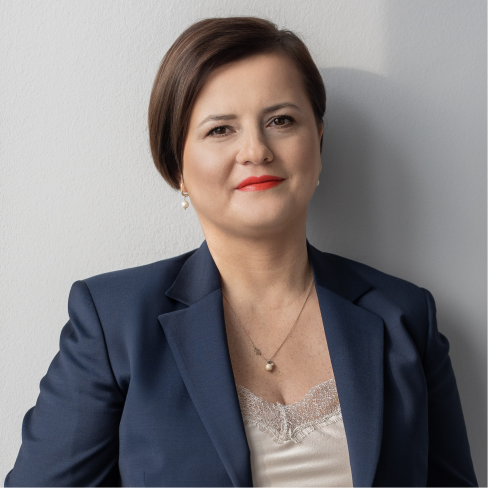
Marta Osiak
Director of Microsoft Dynamics 365 Business Central
Euvic S.A.
Have a topic? Let's talk!
At Euvic Talks we meet people who act, not only talk. Write if you have an idea for an episode.