Industry 4.0: How to Automate Your Factory the Smart Way | Tomasz Sobczak | Euvic Talks
Discover the world of Industry 4.0 in the latest episode of the Euvic Talks podcast. Bartosz Śliwa and Tomasz Sobczak take listeners on a journey through innovative technological ecosystems that are shaping the future of business and industry.
In this conversation, we explore how the concept of Industry 4.0 is influencing the way companies operate and impacting everyday life. The experts discuss real examples of technology projects that demonstrate how new solutions are changing the rules across many industries.
The episode also highlights the importance of collaboration between business and IT in accelerating digital transformation. We also discuss how innovation grants can support business development and help organizations implement new technologies.
Listen to the conversation and gain an expert perspective on the future of technology and business in the era of Industry 4.0.
Bartek Śliwa: Hello, I’m Bartek Śliwa, welcome to another episode of the Euvic Talks podcast.
A podcast where we connect the business world with technology, and today the business we’re going to talk about is manufacturing.
My guest and your guest is Tomasz Sobczak. Hi Tomek.
Tomasz Sobczak: Nice to meet you. Hi.
Bartek Śliwa: Tomek, let’s start as usual with what connects you with business, what connects you with manufacturing,how you ended up where you are today.
Tomasz Sobczak: Yes, it all started back in 2000, an easy date to remember, and I started working at a company that provided services for a global leader in the automotive industry worldwide.
It was a very interesting experience because it was a company with very high standards and culture—a culture of operation, both for the company we delivered to and the one I worked for. So it was really a great school of a structured approach, very focused on making sure that what you do actually brings real profits, tied to analysis, whole design, and so on.
A very, very structured way of working and of manufacturing. And I stayed in that industry.
But not because it just happened that way, but because I really liked it. It’s a field of IT that suits me very well because there are tons of different problems to solve that require getting up from behind the desk.
And that always suited me—as an active person, involved in sports for many, many years, sitting behind a desk all the time wasn’t for me.
And so for many years I worked in this automotive industry, and one day my path crossed with Euvic. It crossed in such a way that the people working in the team I was part of back then were mainly, I’d say, people designed to create solutions,implement them, observe how they function in order to introduce further improvements, and we needed software developers to complete the team.
And it was 2007 when my path crossed with Euvic, where a few people worked in the team I was participating in at the time. Also on those tasks.
Over time, I became the leader of that team, and this collaboration with Euvic lasted for many years.
Going further—because this story is a bit non-standard—the roles at some point didn’t so much reverse, as I took advantage of an opportunity and made them change.
In the sense that, being a bit, to be frank, tired of strictly the automotive area, but still wanting to work in manufacturing and general production, I took advantage of the fact that a new project was starting at Euvic, and I decided at my previous job that enough was enough.
So I moved to Euvic, knowing where I was going, because we knew each other very well. For a while, we even had offices on the same floor and worked together very closely, so it was a very comfortable transition into a company whose way of working really suited me—a certain lightness, quick decision-making, an uncomplicated structure, but most importantly, a huge variety of clients that Euvic works with.
And that was what I was looking for after several, or I’d even say over a dozen years of being in a fairly hermetic place.
Bartek Śliwa: Okay, and now you lead a team.
Tomasz Sobczak: Now I lead a team, yes. Although… I came to Euvic to deliver a specific project.
And somehow it just happened on its own that from a project involving a few people, we are now over 80 people. It really just happened.
It wasn’t a task set before me. It wasn’t my intention. These topics are simply out there.
Clients are interested in these topics. We are able to deliver high-quality services. Not only in software development, but even consulting services.
Which leads to a very natural growth. Bit by bit, piece by piece.
And a few years later, from a small project group of six or seven people, we are currently 80 people dealing with manufacturing—manufacturing and everything around it.
Bartek Śliwa: By manufacturing, do you mean only automotive or…?
Tomasz Sobczak: Oh no, I was running away from that a bit.
The automotive side had gotten a bit repetitive for me, to be honest, although it’s an industry that sets standards quite strongly.
So it’s quite leading and therefore still interesting, so it’s not like I turned my back on it, but I was looking for other challenges.
So now we’re talking about industries like food production, or manufacturing various everyday items, like home appliances, for example. So very diverse, which definitely suits me.
And this diversity isn’t just in terms of what our client manufactures, but also what we, as the entire Euvic group, can deliver to that client.
We have a lot of specializations here, which means we can deliver something interesting and comprehensive.
Bartek Śliwa: Right.
I have to ask, because often when browsing the latest economic news, the term Industry 4.0 pops up.
Why 4.0?
What was 3.0? What was 2.0? What was 1.0?
What does it actually mean?
Is it a set of actions? Is it a trend?
Tomasz Sobczak: Yes, with Industry 4.0, it’s a bit like many people want to stick that label on whatever they offer in various ways.
I’m actually curious how our viewers today will take what I’m about to say, what my perspective on 4.0 is, because it’s probably not entirely conventional.
You asked what it looks like, why 3.0 or earlier 2.0, and so on.
Generally, the development of industry was about this: at first, things were assembled by a team coming in and building a single product together.
Then the assembly line concept was invented, where at individual workstations, different phases of building the project took place and the product was created.
And now I’ll intentionally skip 3.0 for a second.
4.0 was conceived—or maybe the term appeared a few years ago—under the concept that systems and devices supporting the production process should somehow work together, be synchronized in some way, and so on.
We should be able to get information from them. Therefore, there was an attempt, with quite a lot of success, to force hardware manufacturers to publish data from these devices or systems, a sort of standardization of delivering information from individual, colloquially speaking, building blocks that make up the entire solution, so that we could do something more with it.
And defining what that “more” is—well, here it starts getting very, very fluid, because many people say Industry 4.0 is automation.
And I’d say I don’t quite agree with that.
To me, 3.0 was automation. The fact that it didn’t happen everywhere, or wasn’t cost-effective everywhere at the time, is another story, but that was already introducing automation at individual production workstations, replacing people who worked there up until then using various automation solutions.
4.0 is what sits above that layer of automation—everything that allows, thanks to data collected from various devices,adding an intelligent software layer.
Intelligent meaning one that can synchronize certain actions, propose certain conclusions, or even draw conclusions autonomously, suggest optimizations, or even execute those optimizations autonomously.
And I think this is crucial because right now we’re at a point where many companies, especially in small and medium businesses, are catching up on automation—meaning 3.0—while moving toward 4.0.
And in my opinion, there’s nothing wrong with that. That is to say, the order doesn’t have to be strictly sequential; these two phases can actually be implemented simultaneously, because we currently face huge wage pressure. That’s the reality.
We also have the fact that many people in current and slightly older generations, who entered the labor market a few years ago, belong to a generation with a high level of higher education.
It’s increasingly hard to find workers who will perform repetitive, often monotonous work for many years.
Hence the search for how to supplement human labor in these industrial plants. That’s where automation comes in.
Bartek Śliwa: Right. Reading between the lines, I’ve gathered the impression that a lot of companies are still at the 3.0 stage. Or maybe even earlier, judging by your smile.
Tomasz Sobczak: That’s right.
I wanted to say that a driver to jump to 4.0 should be asking oneself: do I have the right data, or am I even collecting data that I can do something with to achieve this automation?
Bartek Śliwa: Do you see it similarly?
Tomasz Sobczak: Similarly.
I’ll expand on that a bit, because a few or a dozen years ago… I was actually part of a team that built, developed, and successfully implemented a massive, giant system across a dozen plants worldwide for a leading automotive company,covering almost everything in the factory.
From production planning, through production control, quality control, logistics processes, shipping goods, receiving materials, internal logistics—one huge, gigantic system cleverly split into modules, but still one big system.
And now, in my opinion, we should move away from that kind of approach.
Because just like we have agility in many areas of life, we should look for it here too and address individual problems step-by-step with targeted solutions.
That’s my opinion, that’s my philosophy.
What I’m getting at is that you can carry out Industry 4.0 initiatives—meaning a level of intelligence and optimization through software—by addressing small areas of the factory with some automation, or even without it.
You could even say skipping that step slightly, as long as you have real sources of data… Quite frankly, humans aren’t the best source of data; they make mistakes, so it’s better to collect it from devices, but there’s no rule saying you must go from 2.0 to 3.0 before you can even think about 4.0.
In fact, I’m strongly opposed to that approach.
I firmly believe it’s essential to know what goal you want to achieve, what problem you want to solve, and focus on solving that problem with a vision for the future, without necessarily implementing giant, revolutionary changes.
Because the world is moving so fast that we’d end up suffocating under the weight of our own revolution.
Bartek Śliwa: Right.
So the question is: how to start?
If I’m the head of a manufacturing enterprise, and maybe I’ve heard about some grant programs, because I know there are plenty right now…
Where should I look, where to start, or where to get advice?
Tomasz Sobczak: Yes.
In my opinion, it’s worth starting in a place where something I need has already been implemented, for instance.
What I really like is that many companies—not just in IT, but across various industries—have started sharing information about how to help each other, forming groups, and so on. So it’s worth looking at what friends or acquaintances are doing and taking inspiration from that, but especially taking inspiration from…
Bartek Śliwa: Nobody has ever called the competition so nicely before.
Tomasz Sobczak: …but especially taking inspiration from who advised on what actually needed to be done. Because…
In my opinion, it’s not worth copying solutions; it’s worth identifying who solved what problems with whose help.
Because very similar problems can be solved in several different ways in two different places. And very often, in a really simple way.
And having that long-term experience across various industries, and not being alone—having a whole team behind me—we love getting up from behind our desks and heading out to the factory floor to talk about what the problems are, what the challenges are, what the goals are, to see how things currently work. And based on our experience, ask: why not this way? Could we do it that way instead? And kick off a discussion, a workshop.
And again, we’re not talking about a workshop where you sit in a locked room for two days and come out with a finished idea. No.
It’s about triggering a conversation and considering whether topics could be solved in a completely different way than initially thought.
I actually have an interesting case like that right now, though it’s in a very early challenge phase.
Bartek Śliwa: Okay.
Where does software fit into all of this? Because I understand data aggregation and processing, but is software used anywhere else?
Tomasz Sobczak: Yes.
I’d say in a lot of places.
And here I’ll circle back to building one giant solution in the past, like MES (Manufacturing Execution System) class or WCS class, which are automated warehouses controlled via software.
Software isn’t just up at the Enterprise level or between Enterprise and execution anymore.
More and more, we have plenty of solutions that are somewhat autonomous or allow for very simple programming so they can carry out specific tasks.
Examples: intralogistics solutions with various mobile robots, which have built-in systems and so on.
You need to add a layer that tells them: pick something up from there and take it over there, synchronize those actions,know when to trigger them, and so on.
There are collaborative solutions, like cobots working directly alongside humans. You can apply certain algorithms to them, and then the operator working with the robot actually teaches it. So right there.
We go much lower than just collecting data and passing it to other systems.
We go down to collecting data and using it in real time to control material flow, machine calibration, switching production from one line to another, or identifying causes of downtime and breakdowns so you get the reason why something happened, not just the fact that it happened.
So there are tons of areas like this.
That’s why I think it’s worth meeting up, talking, exchanging ideas, and addressing a specific pain point rather than coming in and saying, “I have this huge product.”
Bartek Śliwa: Right, so could I ask you to walk us through a sample case study you’d like to share—from the moment the process starts (since I assume it originates from business needs, not technology) to the analysis phase, workshop, and actual implementation?
Tomasz Sobczak: Sure.
God, so many examples come to mind right now.
I’ll go with the freshest one, which is quite complex and very large, but makes a great example because it happened in distinct stages, step by step.
How did it start? Yes, definitely from a business need.
The client’s IT department is obviously needed during the project, but in my preference, IT should be a collaborative element, not the one dictating where the solution should go, because the solution must support business goals.
It obviously needs to fit within the frameworks existing in the enterprise that IT knows well. That’s a given.
However, we usually start collaboration by asking “why?” and “what is the goal?”.
Once we get information on the goal, the second set of questions is: okay, how will we measure achieving this goal, and what will be the metric of success?
Because—skipping to the very end for a moment—it’s crucial that after deploying a solution (which often isn’t just an IT solution, by the way), you verify whether those goals were achieved.
Because that’s the measure of success, not just having a wonderfully working application that doesn’t deliver the expected benefits.
So meeting with the business side to establish those goals and determine what’s critical for the timeline is key.
And again, it’s not about two weeks versus four weeks or six months, but about the sequence of actions, so you focus first on where you can get the biggest wins.
And then gradually, if there’s willingness, continue rolling it out. So from that angle.
Next is a solid definition on paper of what those goals are, how to achieve them, the required budget, and the calculated ROI, since many of these initiatives aren’t done for the sake of it, but to bring a tangible business benefit.
So definitely business-driven.
And we work with the business team until the very end. When we prepare a solution and go to deploy it, we verify it with the business stakeholders.
We’re right there on the factory floor with them to see if they’re satisfied.
In fact, we spend time with the operators using these solutions to see if it’s comfortable for them to work with, so we can propose tweaks or learn if we made a mistake somewhere and quickly fix it.
To be more specific, we’re currently working on a project—at the stage of delivering a solution—class MFC (Material Flow Control) or WCS (Warehouse Control System), highly automated.
We’re talking about a setup where robots build pallets from products coming off the production line.
We have mobile robots bringing empty pallets, taking away full ones, swapping out various dividers, and so on.
They transport them to automated stretch-wrapping and labeling stations, store them in the warehouse, and later retrieve them for shipping, and so forth. So a high level of automation.
We built this step by step with the client, where initially they just wanted to automate pallet building. Transport was still handled manually.
The next stage they wanted to achieve—and we’re right on the eve of Go-Live—is eliminating manual transport so pallets are moved automatically.
Mainly because working conditions there are tough—it’s food production with very low temperatures.
The following stage will be automating the shipping area, so it can truly be implemented in phases while monitoring if the targeted results are being met, with the option to pause at any point.
Because it’s not about defining everything perfectly right at the start, when over the course of a year or 18 months of implementation, ideas can naturally evolve—even when dealing with heavy machinery.
Bartek Śliwa: Agility is required everywhere.
Tomasz Sobczak: Absolutely. The world moves so fast that without agility in every area, you won’t make it.
Bartek Śliwa: Okay.
Besides analysis and software implementation, do you also deal with hardware?
Tomasz Sobczak: Our specific team doesn’t. We focus on the software layer.
However, both within our capital group and through external partners, we have companies specializing in specific fields.
And as an integrator, we bring it all together into a single whole.
Within the group, we have companies specializing in AI, production planning solutions, or intralogistics mobile robots for moving pallets, boxes, and so on.
We have external partners handling heavy hardware. If an automated warehouse needs to be built, that involves tons of steel structures, panels, etc. I call it “ironwork”—so we have partners for that.
What clients have been looking for lately—and this is very important—is that in large industrial projects involving six or even ten different vendors, coordinating all those moving parts and finding compromises between vendors is exhausting for the client.
So clients increasingly look for a single integrator to deliver the whole package through a network of trusted partners,taking on the heavy lifting of project management.
So short answer: hardware, yes as a group; my team focuses strictly on software.
Bartek Śliwa: Listening to all this, I get the impression that this is only for large enterprises. But you mentioned earlier that small and medium businesses are entering this space too. I have two questions here: do you have an example of a lighter project, not for giant conglomerates, but for smaller-scale companies?
And is that tied to what I touched on earlier—can smaller companies count on grant support, like EU funds, since Industry 4.0 seems heavily driven by agencies assisting with funding?
Tomasz Sobczak: Yes, okay.
I’ll start with the first point. The example I gave earlier was a very large project lasting many months.
In contrast, here’s an example from quality control: a client asked us for a solution to support a quality inspector who has to check product quality across various production lines several times per shift using a relatively simple digital form.They take a tablet under their arm and go to the line to collect data electronically, instead of writing things down on paper and re-entering them into Excel spreadsheets later.
So we built that solution very quickly—literally a matter of a few weeks.
And that started a long-term collaboration, because then it was: “Okay, now I’d like different query options.”
Then: “Now I’d actually like a form configurator, because depending on what I’m manufacturing, the questions differ.”
Later: “Now I’d like to pull certain parameters directly from the machines.” And that’s where we paused.
Meaning: wait a second, let’s talk about whether you want the operator to walk up to the machine and copy parameters down, or if we should collect them automatically in real time so you get more data, more frequently, and can make better use of it.
So we started gradually—first manual entry, then connecting a few machines, but not all (since not all were modern enough to output data digitally). We started gathering data step by step, and the process evolved over a little more than two years.
In this way, we guided a relatively small enterprise that simply commissioned a few weeks of work every now and then to enhance the product.
So yes, you can definitely do interesting things for smaller companies too.
And most importantly, those projects yield tangible results that the business actually needs.
Regarding grants, small and medium enterprises are actually somewhat privileged compared to large corporations.
With many programs—like the current discussion around our National Recovery Plan (KPO)—EU funding programs often target SMBs rather than the biggest players, though some exist for large ones too.
What’s important is that we also help prepare these applications.
I even have someone on my team who spent many years writing and evaluating these grant applications, so we know this domain well.
We aren’t just a development team; we’re a consulting team, and I think that’s the direction IT as a whole should be heading.
So EU grant programs are one avenue.
And again, we even have resources for this within our group.
We have an internal organization that invests in or accelerates startups, helping turn good ideas into actual products and ultimately driving commercialization and deployment.
We also have a grant program for these startups, and businesses looking for innovation come to us to source startups that can deliver specific solutions.
So we can provide comprehensive assistance, including financing topics.
Bartek Śliwa: Sounds great. It really works well.
Okay.
Tomek, to wrap up, a signature question for our podcast: could you share an inspiration with our viewers? It could be an experience, a habit you introduced, a movie, or a book.
Tomasz Sobczak: Okay. None of the above!
Meaning, none of the things you listed, because something else came to mind… Last Saturday, I was talking to my 14-year-old son, who is finishing 8th grade and deciding on high school.
We started with an innocent conversation about choosing a high school and his thoughts on it, which eventually turned into talking about future careers and what he’d like to do long-term.
And my 14-year-old hit me with a heavy question: “Dad, what would you suggest?”
And let me tell you, that was a tough one. A really tough question. I managed to dodge giving a definitive answer,fortunately, since he doesn’t have to pick a final profession just yet, though high school choice is coming up.
But I arrived at this conclusion: the world is moving so fast that I cannot tell my son today what job he should do in 10 years, because I suspect that job doesn’t even exist yet.
And why am I bringing this up? Bringing it back to manufacturing: it’s about focusing on things right in front of us that can bring real value or solve an immediate problem, rather than trying to build massive 10-year strategies and grand revolutions across manufacturing plants. Because the world changes so fast that before we finished one revolution, we’d need to start a second one—and heaven forbid it points 90 degrees in a different direction.
So my takeaway—and what I encourage my team to do—is: let’s look at what’s around the corner, not what’s over the horizon. You can’t see over the horizon anyway, but you can peek around the corner and see what’s coming next.
Bartek Śliwa: I think so too. That’s an interesting thought.
I think not just me, but our viewers will be reflecting on that after listening to this episode.
Awesome, thank you so much.
Tomasz Sobczak: Thank you very much.
Bartek Śliwa: That was another episode of Euvic Talks, see you next month!
Meet our guest
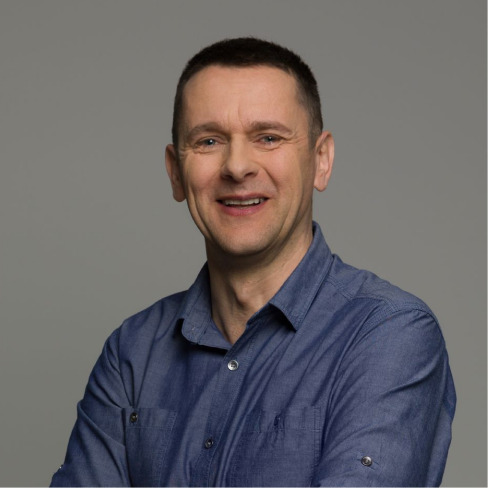
Tomasz Sobczak
Project Manager
Euvic S.A.
Have a topic? Let's talk!
At Euvic Talks we meet people who act, not only talk. Write if you have an idea for an episode.