Why AI Is Creating More Engineering Work, Not Less: 5 Myths the Data Debunked
In February 2026, a viral essay from Citrini Research painted a grim picture of an AI-driven economic collapse: S&P 500 down 38%, unemployment at 10.2%, and white-collar workers permanently displaced by AI agents.
Markets moved. Software stocks fell. The narrative spread fast.
Then Citadel Securities fired back with a data-driven macro brief authored by Frank Flight, an Oxford-trained macro strategist.
The rebuttal was methodical and grounded in real-time labor market data. In reality, the doomsday scenario confuses the potential of AI with the actual pace of its economic deployment.
The more useful question for any company that builds software is what the data actually shows right now. And the data tells a story that runs directly counter to the displacement narrative.
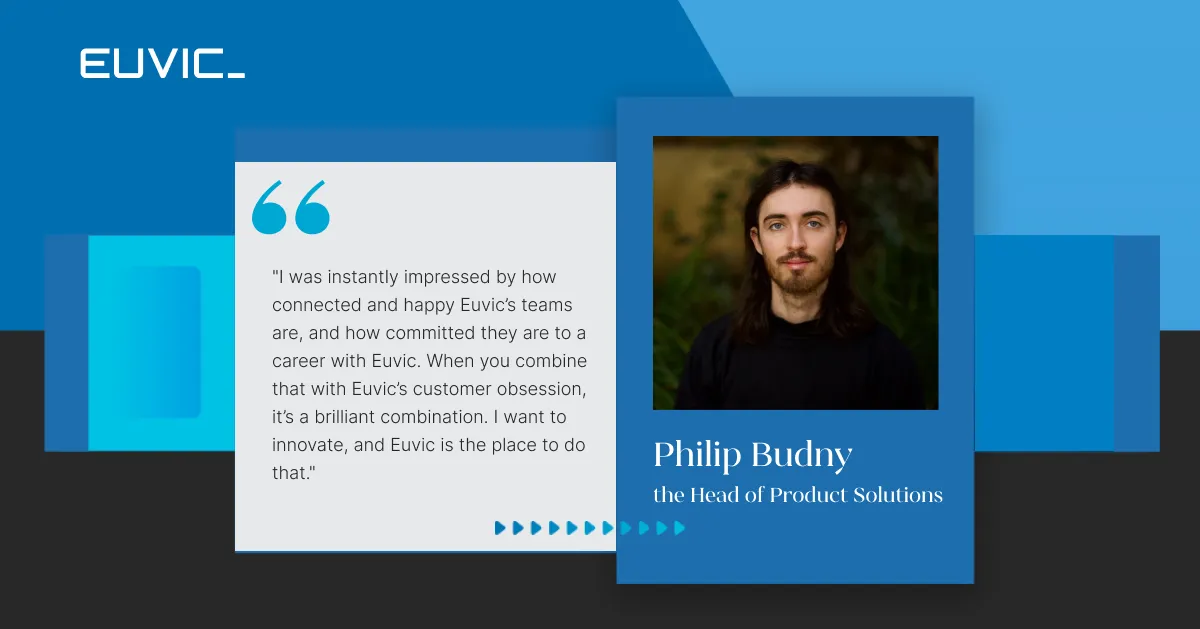
The data backs that view. Our COO Christopher Krzoska put it this way:
.webp)
There's more engineering jobs, not less. There's more work that needs to be done. When the cost of doing something decreases, the demand for it increases — there are so many things that didn't make sense to build six months, a year, two years ago that make sense now."

The explanation for why runs through an economic principle that predates AI by over 150 years.
The Jevons Paradox Explained
In 1865, economist William Stanley Jevons observed that more efficient steam engines did not reduce coal consumption. They dramatically increased it.
When efficiency improves, the standard assumption is that consumption of the underlying resource falls. Jevons showed the opposite: cheaper production made it economical to build factories that never would have existed before. Total demand exploded.
AI is doing the same thing to software. Code generation tools have lowered the cost of building certain features. Every newly viable project still needs experienced people to architect it, secure it, and own it in production.
What the Data Actually Shows
Three datasets make this concrete.
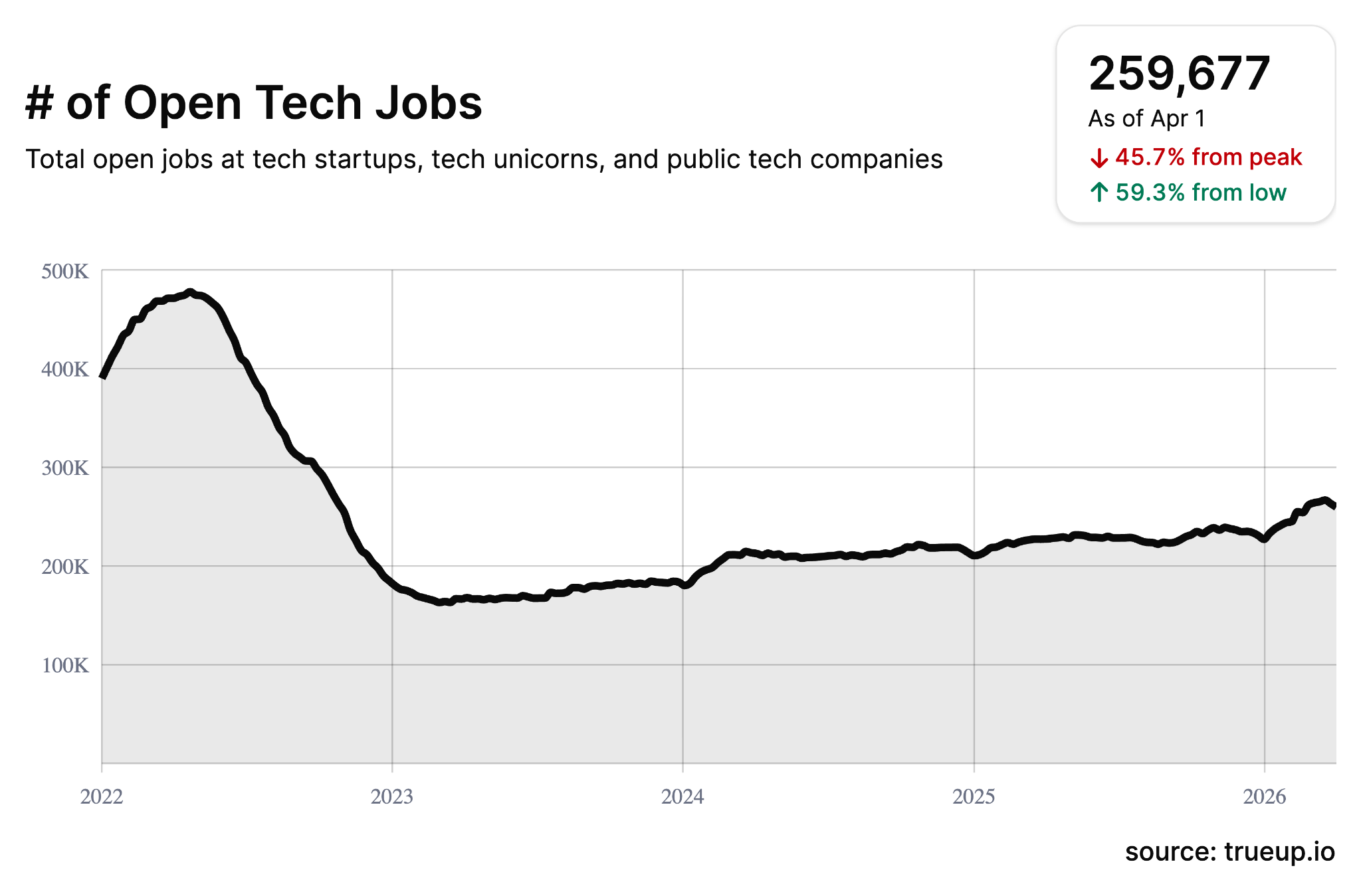
First, open engineering job postings. According to Trueup’s tracking data, open engineering roles hit a floor of approximately 37,982 in early 2024 and have climbed 78% since, reaching 67,665 as of March 2026. That is the highest count of open engineering roles in over three years.
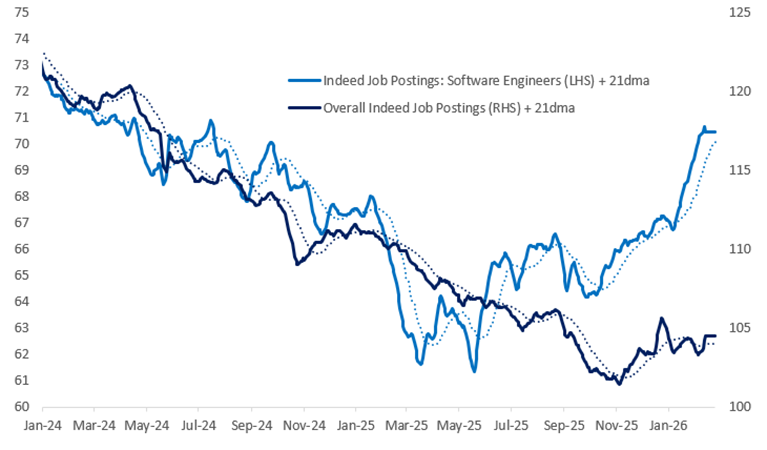
Second, job posting velocity. Citadel’s analysis of Indeed data shows software engineer postings up 11% year-over-year in early 2026, outpacing the broader labor market by a significant margin. Engineering demand is accelerating while general hiring has not.
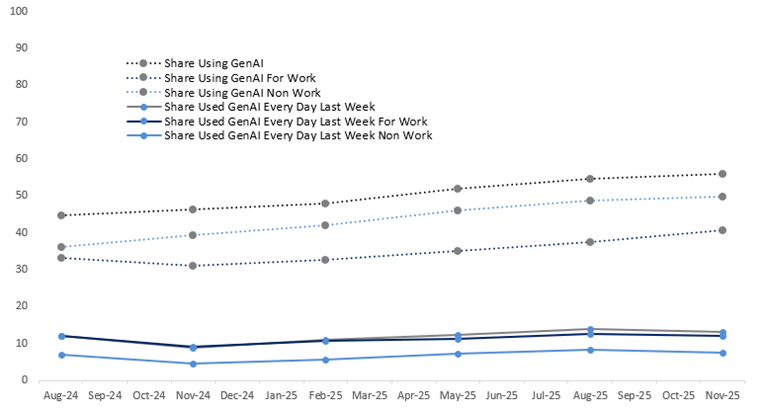
Third, actual AI usage intensity. The St. Louis Fed’s Real Time Population Survey tracks not just whether people have tried generative AI, but how intensely they use it for work. As of November 2025, approximately 55% of working-age adults reported using AI at all.
Only around 12% reported using it every day for professional work. That daily-for-work figure has barely moved over 15 months. Citadel describes this as “unexpectedly stable” and notes it presents “little evidence of any imminent displacement risk.”
The adoption S-curve is early. The internet took over a decade to reach the penetration levels AI has hit in three years. Economies don't restructure overnight around a tech that 12% of professionals use daily.
The need for good engineers has actually gotten more important, not less. A good engineer can be ten times better than another. Now, with AI, that leverage is a hundred times what it was. The need for good engineers has gone up."
5 Myths the Data Debunked
Myth 1: AI tools make engineers obsolete
Production software does not work that way. Getting a system to hold up under real load, in a regulated environment, with actual users depending on it requires architecture decisions, security judgment, and accountability that AI tools simply do not provide.
Open engineering roles are at a three-year high [link to Trueup data]. If AI were replacing engineers, that number would be falling.
Myth 2: The software job market is shrinking
The 2022–2023 contraction came from over-hiring during the COVID boom and rising interest rates tightening venture capital. The data since then has moved in the opposite direction:
- Software engineer postings are up 11% YoY, outpacing the broader market
- New US business applications hit nearly 550,000 per month in late 2025, each needing software to run
- ~2,800 data centers are planned for US construction, requiring engineers to spec, build, and maintain them
The market composition is shifting. Total demand is not falling.



Myth 3: AI adoption is moving fast enough to displace software engineers in the near future
The intensity data tells the real story. Around 55% of working-age adults have tried generative AI. Only 12% use it every day for professional work, and that figure has barely moved over 15 months.
The internet took over a decade to reach comparable penetration, and another decade before it restructured most industries. Economies do not reorganize overnight around a technology that 12% of professionals use daily.
Myth 4: Any vendor with AI capabilities can deliver production-grade software
Lowering the floor of software development is not the same as raising the ceiling. The AI-enabled version of the vendor credibility problem follows the same structure it always has: polished decks, thin execution teams, and no real ability to scope the work. A prototype built in a sprint is not a production system.
The outsourcing industry has always had vendors who lead with capability they cannot deliver. Plenty of firms have built careers out of winning RFPs with polished decks and thin execution teams.
The AI-enabled version of that problem follows the same structure: vendors who have retooled their pitch around AI without the engineering depth to back it up. A working prototype built in a sprint is not a production system.
The gap between them is where projects stall, costs climb, and CTOs start making calls to find a replacement.
On one side you've got the low-cost body shops — they often struggle to get it right the first time. On the other side, you've got consulting companies built to win deals, at the expense of delivery, so you end up paying a lot more for value you never receive. That's why we start every engagement with a workshop. You might find out at the end of it that the product doesn't make sense to build — and that's a much cheaper way to learn that than twelve months in."
Part of what separates credible partners from body shops is the willingness to do discovery work before writing a line of code. (Our engagement model at Euvic, for example, starts with workshops.)
Myth 5: AI changes who you partner with
Every vendor has access to the same tools. Selection still comes down to what it always has: engineer quality, domain experience, process rigor, and relationship accountability. What AI has changed is how fast the consequences of a wrong choice arrive.
A weak team now makes expensive mistakes at greater velocity.
It still matters who's leveraging the AI. If an engineer doesn't have the business context or the skill and competency, they're going to implement it in a frankly ineffective way. Good people still matter."
For a deeper breakdown of what separates vendors who deliver from those who disappoint, see our guide on the 7 most common outsourcing mistakes.
What This Means For Forward-Thinking Companies Building Now
The data does not leave much room for ambiguity. Engineering demand is up. AI adoption intensity is lower than most headlines suggest. The quality gap between vendors is wider than it has ever been, because the speed at which that quality gap shows up in production has shortened.
- Budget and headcount planning should reflect rising engineering demand, not a forecast of contraction that the data does not support.
- AI tools amplify the team you have. A strong team ships better and faster. A weak team ships broken things faster. The talent question is more important than the tooling question.
- Any vendor leading with AI credentials without demonstrating engineering depth is running the same play that low-cost offshore shops have always run, with a different label on the deck.
- The companies pulling ahead right now started discovery before they started building. Scoping rigor and architecture decisions made before a line of AI-generated code is written determine whether the project succeeds or stalls.
We have been doing this kind of work for over 20 years, across financial services, government, fintech, and manufacturing. A document management platform now trusted by the FAA, DOJ, and NIH was built from the first line of code through 20 years of continuous development. A financial advisory firm managing $29 billion in AUM achieved a 300% productivity improvement.
Great engineers have never been more in demand. The people who understand that are already hiring them.
Euvic is a competitive advantage for us. The technical excellence that Euvic has brought is not easily matched and their support has become integral to our growth strategy.

Euvic is a competitive advantage for us. The technical excellence that Euvic has brought is not easily matched and their support has become integral to our growth strategy.
Euvic is a competitive advantage for us. The technical excellence that Euvic has brought is not easily matched and their support has become integral to our growth strategy.

Talk to Your Local Euvic Team






.jpg)
.jpg)
.jpg)
%20(1).png)
.png)
.png)

.jpg)
%201%20(1).jpg)

%20(1).png)








.webp)